
TLDR
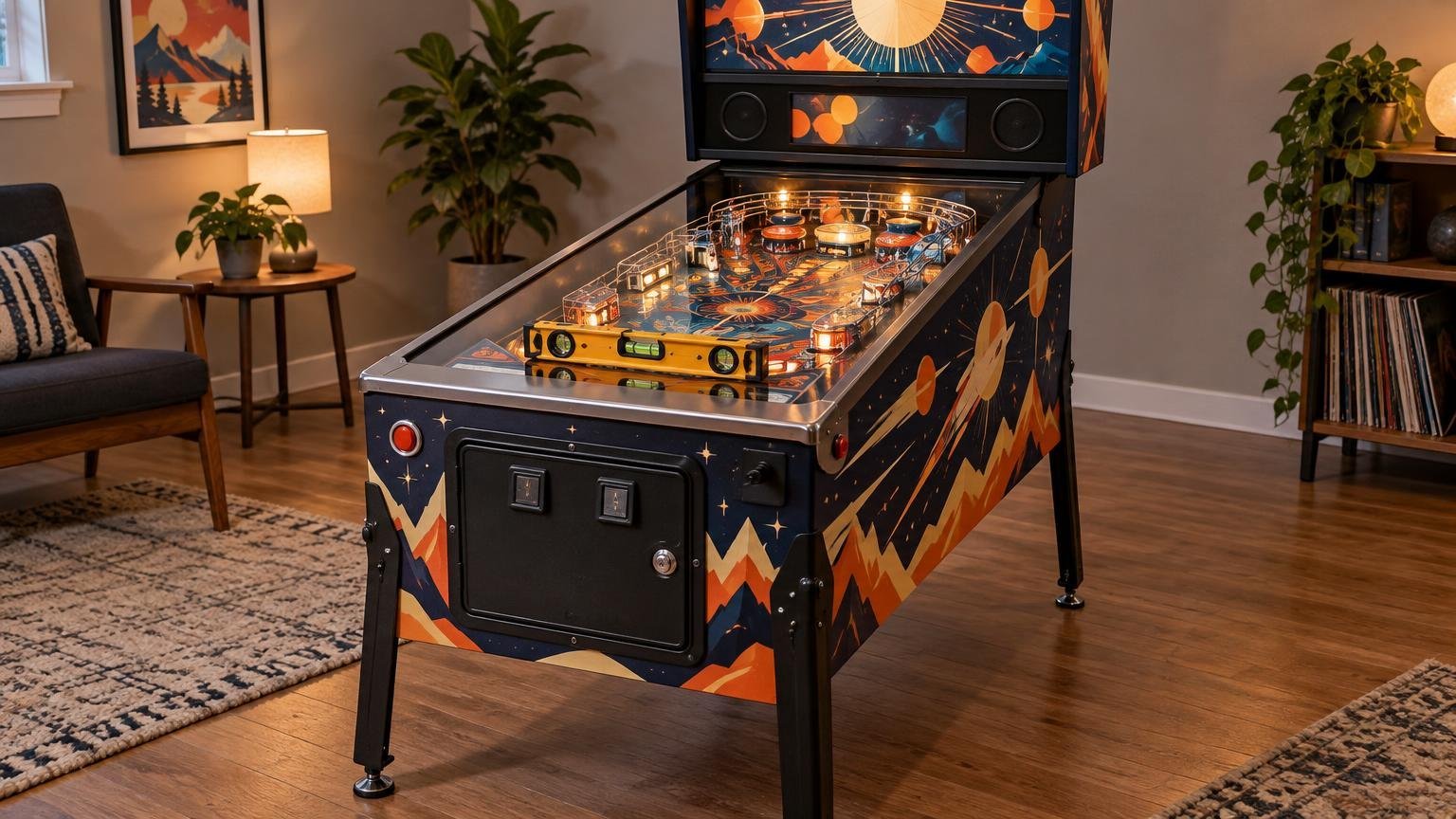
The key to learning how to level a pinball machine is recognizing that “level” has two meanings. The machine should be level from left to right, but its playfield should retain an intentional front-to-back slope, called pitch. Look up the model-specific pitch in the manufacturer’s manual, follow its leg-leveler sequence, check the playfield rather than assuming the glass shows the same angle, and retest after the machine settles.
Do not try to make the playfield flat. Stern documentation provides model-specific examples ranging from a 6–7 degree playfield angle for Jurassic Park Home Edition Plus to 6.5 degrees for The Munsters. Those figures illustrate why the manual matters; they are not universal settings for every pinball machine.
A good setup also depends on the room. Before adjusting anything, confirm that the machine is in its final indoor location, has stable footing, can reach a grounded outlet, and leaves enough access for players, glass removal, coin-door access, and future maintenance.
How to level a pinball machine without removing its intended pitch
Leveling is easiest when treated as a sequence: place the machine, identify its specified pitch, establish front-to-back height, correct left-to-right lean, and then test. Avoid chasing ball behavior by randomly turning different levelers. That makes it difficult to know which adjustment produced the result and may leave the cabinet unstable.
1. Put the machine in its final position
Complete the difficult part of the move before making precise adjustments. A machine that is pushed across the room, turned, or moved onto a different floor surface will normally need to be checked again. Use the moving instructions for the specific machine and get sufficient help. The cited Stern manual requires at least two people to move and maneuver its games and notes that a boxed machine weighs more than 250 pounds.
Stairs, tight turns, thresholds, and sloped floors can make a nominally simple move unsafe. If the route requires improvised lifting or leaves someone supporting most of the cabinet weight, stop and use experienced help. Measure the entire route—not only the final floor area. The broader home pinball setup guide covers delivery access, glare, room suitability, and service space in more detail.
2. Find the specified playfield pitch
Consult the machine’s manual before turning the levelers. Look for setup, installation, leveling, or leg-adjustment instructions. Record both the pitch target and the manufacturer’s prescribed adjustment sequence. If the manual provides a built-in bubble reference, use it as directed.
Be careful about where an angle is measured. Stern explicitly distinguishes the playfield angle from the angle of the playfield glass in its Jurassic Park Home Edition Plus guidance. A reading taken from the glass or cabinet trim should not automatically be treated as the playfield pitch. Stern’s model-specific setup instructions show how this distinction is handled on that machine.
3. Follow the model-specific leveler sequence
There is no responsible universal instruction to adjust the same pair of legs first on every machine. For Jurassic Park Home Edition Plus, Stern begins with both front levelers in their lowest position and uses the rear levelers to adjust the playfield bubble. That is a useful example of a documented process, not a substitute for the manual belonging to another model.
Keep the cabinet supported and stable while making adjustments. Use a helper or suitable moving equipment where the manual requires it, and do not put hands or feet beneath an unsupported cabinet. Make incremental changes and keep track of which leveler was turned. If a leveler is seized, bent, damaged, or difficult to reach safely, treat that as a service problem rather than forcing it.
4. Check left-to-right level separately
Once the front-to-back pitch is set, check lateral level. The cited Stern manual describes several options: roll a pinball down the center of the playfield, or use an external bubble level, digital level, or smartphone level app.
A center-ball roll can reveal an obvious lean, but interpret it cautiously. Playfield inserts, wear, dirt, hardware, and nearby features can affect the path. A repeatable pull toward one side is a reason to verify the machine with a measuring tool; it does not prove that leveling is the only possible cause.
If one side is low, consult the manual and make a controlled lateral correction without losing the desired front-to-back pitch. Recheck both axes after every meaningful adjustment because changing one corner can affect more than one reading.
5. Test stability and gameplay
After adjustment, confirm that all feet are bearing weight and that the cabinet does not rock during normal use. Restore power according to the manual and run any relevant diagnostics. Stern’s cited documentation directs owners to check operation through diagnostics after setup.
Play several games before deciding that the setup is finished. Watch for cabinet movement, unusual ball drift, and a game that feels dramatically faster or slower than expected. If lateral drift remains after the machine measures level, investigate cleanliness, ball condition, playfield condition, and mechanical issues rather than continually altering the legs.
What angle should a pinball machine use?
The correct answer is the angle specified for that game. Jurassic Park Home Edition Plus uses a documented 6–7 degree playfield angle, while the cited manual for The Munsters specifies 6.5 degrees. Older machines, different cabinet designs, and other manufacturers may use different references or methods.
Pitch materially changes play. The Munsters manual says increasing pitch beyond its specified setting can make play faster and more difficult. A steeper setup may therefore change shot timing, returns, and ball speed, but that does not make it an automatic upgrade. Start with the documented setting so that maintenance observations and gameplay comparisons have a known baseline.
If you intentionally experiment later, record the original setup first and keep changes reversible. Do not use a more aggressive pitch to conceal weak flippers, dirty surfaces, worn balls, or another maintenance problem.
Plan the room before fine-tuning the level
A perfectly adjusted game can still be a poor household fit. The final position needs to support delivery, play, cleaning, and service—not merely contain the cabinet. For a deeper planning pass, see how much space a home pinball machine needs.
| Planning item | What to verify | Why it matters |
|---|---|---|
| Delivery route | Doors, turns, thresholds, stairs, ceiling restrictions, and the approach to the final room | The final location is irrelevant if the machine cannot reach it safely. |
| Player area | Comfortable stance and movement around the front of the cabinet | Players should not be pressed against a wall, doorway, or furniture. |
| Service access | Coin door, glass removal path, backbox area, and room to lift the playfield safely | Routine inspection and repair become harder when the cabinet is trapped in a tight recess. |
| Floor and position | Stable footing with no rocking or obvious movement | A shifting cabinet will not retain a reliable setup. |
| Light and environment | Glare, direct sunlight, temperature, and humidity | Glare impairs visibility, while unsuitable environmental conditions can damage the machine. |
| Power | A reachable grounded outlet that complies with the machine documentation | The setup should follow the electrical requirements specified by the manufacturer. |
| Household noise | Distance from bedrooms, offices, shared walls, and quiet-use rooms | Mechanical pinball sounds remain even when speaker volume is reduced. |
Leave practical maintenance access
Routine ownership involves more than wiping the glass. Manufacturer maintenance guidance includes checking the playfield, balls, rubbers, switches, loose parts or wires, and the continued operation of the levelers. Leave enough space to remove the glass, reach the coin door, and lift the playfield using the documented procedure. A condition-led home pinball cleaning schedule can help organize those recurring checks.
Account for mechanical noise and vibration
Lowering the speaker volume does not silence a pinball machine. Flippers, balls, coils, callouts, music, fans, knockers, and cabinet vibration all contribute to household noise. A room beside a bedroom or work area may be inconvenient even when the machine sounds reasonable during a brief daytime test.
Listen from the adjoining rooms as well as beside the cabinet. If the household has sleeping children, shift workers, remote meetings, or shared walls, decide on acceptable play hours before committing to the location.
Use a suitable indoor environment and documented power connection
The cited Stern manual recommends an indoor, climate-controlled location away from direct sunlight and warns that excessive moisture or humidity can cause long-term damage. It also directs owners to use a grounded outlet. Follow the electrical label and manual for the individual machine rather than assuming universal requirements for circuits, extension cords, or accessories.
Recheck level after moving or during maintenance
Level and pitch are not one-time considerations. Stern’s maintenance guidance includes checking that the playfield remains level at the proper pitch and confirming that the levelers operate freely. Recheck after relocating the game, noticing cabinet movement, or seeing a new and repeatable side-to-side tendency.
Do not diagnose every strange ball path as a floor or leveler problem. If the measurements are correct but gameplay remains abnormal, the next step may involve cleaning, inspection, diagnostics, or repair. Persistent electrical faults, damaged levelers, unstable legs, and inaccessible mechanical problems belong with a qualified technician; owners in the service area can review Utah pinball machine repair options without attempting a risky workaround.
Renting can test whether the room really works
For buyers who are unsure about noise, usage, or room fit, a temporary installation can provide information that measurements cannot. Rock Custom Pinball states that its Utah pinball rentals include delivery, setup, leveling, and a machine ready to play. Availability, territory, timing, and terms should be confirmed for the specific request.
The practical next step
Begin with the manual, not an assumed universal angle. Put the machine in its final position, establish the documented front-to-back pitch, correct left-to-right lean separately, and verify that every foot is stable. Then test play and recheck both axes.
If the setup cannot be completed without unsafe lifting, forced hardware, or guesswork around a persistent gameplay problem, stop at observation and measurement. Professional setup or repair costs less than an injured mover, damaged cabinet, stripped leveler, or misdiagnosed machine.