TLDR: Do not assume every pinball playfield needs wax. Check the exact machine manual, identify whether the surface is original or restored, and inspect the playfield and balls with the power off. Some manufacturer manuals explicitly include cleaning and waxing in scheduled maintenance, while owner practices for intact modern clear-coated games vary. If the surface is lifting, flaking, deeply scratched, sticky, or otherwise damaged, stop before applying another product.
If your question is “pinball wax playfield needed?”, the practical answer is maybe—but inspection comes before product. Wax can be part of legitimate routine maintenance when the manufacturer specifies it and the surface is sound. It is not a universal cure for slow play, visible ball trails, roughness, or damaged artwork.
The safest decision is based on four things: the machine’s manual, the type and condition of its playfield finish, the condition of its pinballs, and the symptoms you are trying to correct. That condition-led approach also fits a broader home pinball cleaning schedule better than waxing by habit.
Is pinball wax playfield needed for every machine?
No single waxing rule covers every manufacturer, era, finish, or restoration. A newer machine with an intact factory finish, a worn vintage playfield, and a playfield that has been refinished by a restorer are three different maintenance situations. A procedure suitable for one may be unnecessary or harmful on another.
Manufacturer documentation should take priority when it is available. For example, Stern’s 2024 W5/John Wick Pro manual includes cleaning and waxing the playfield in its regular maintenance guidance and presents a monthly or 500-game interval for that machine. Consult the W5/John Wick Pro operation and parts manual for the complete model-specific wording and procedures. An earlier Stern Heavy Metal manual also includes clean-and-wax language in its scheduled maintenance guidance.
Those examples establish that waxing is recognized maintenance for those documented machines. They do not establish a universal interval for every Stern title, much less every pinball machine. Use your own manual’s schedule rather than transferring the John Wick interval to a different model or era.
Start with a safe, power-off inspection
Turn the machine off and follow its manual for removing the lockdown bar and glass. Keep electrical diagnosis outside the scope of routine surface cleaning. If the machine has an electrical smell, intermittent power, unexpected resets, exposed wiring, or a mechanism that energizes unexpectedly, stop and address that as a service issue instead. A surface product will not resolve an electrical or mechanical fault.
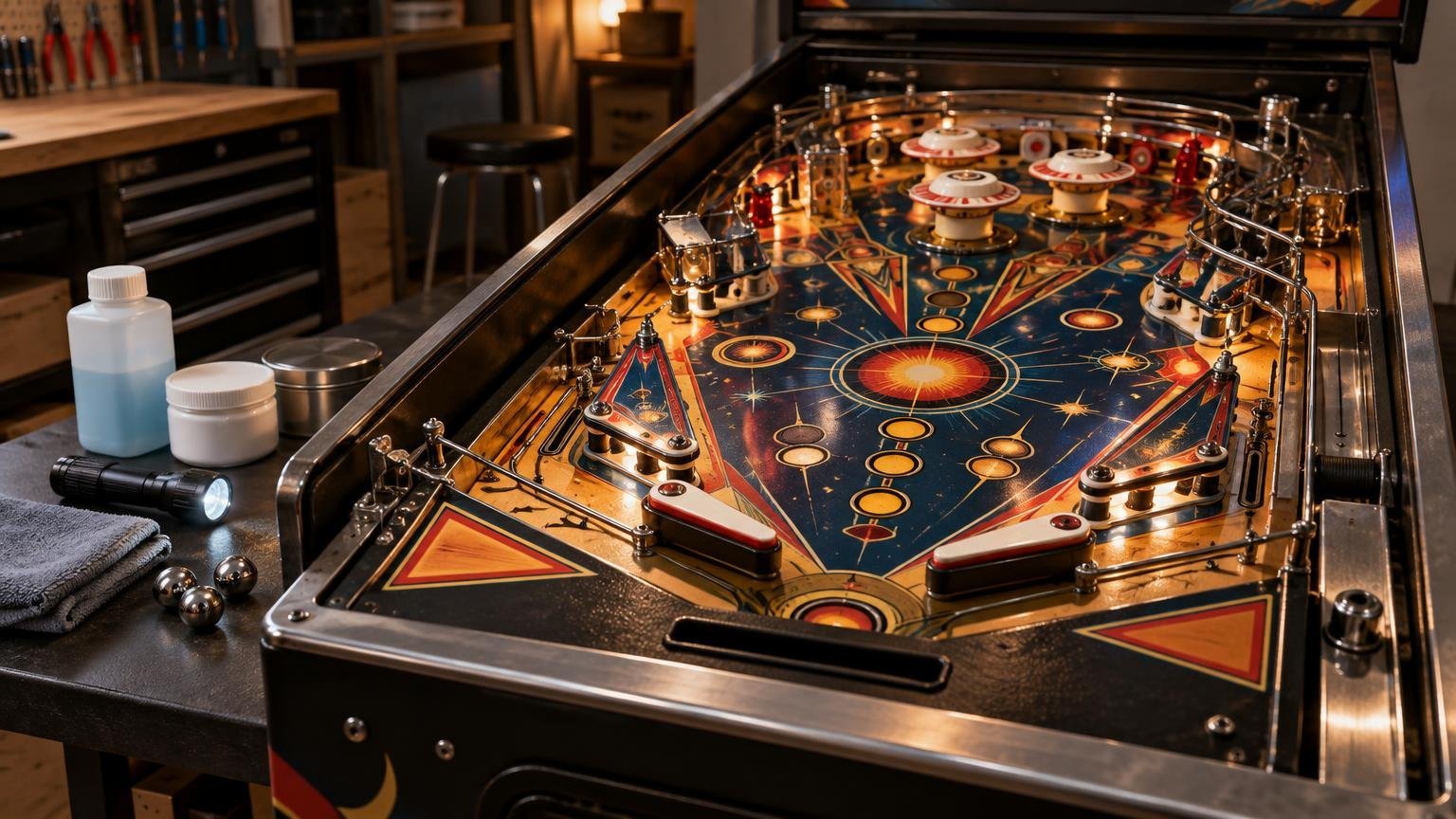
With the glass removed, use good room lighting and inspect before wiping or applying anything. You are trying to distinguish ordinary contamination from physical deterioration.
- Look for loose screws, nuts, posts, plastics, or playfield hardware.
- Check rubbers for cracking, heavy dirt, or deterioration.
- Look for ball trails, loose debris, haze, and localized residue.
- Inspect around inserts and high-traffic areas for raised edges, lifting material, cracks, or visible wear.
- Check whether anything is dragging on the playfield or obstructing the ball.
- Examine every installed ball for scuffs, corrosion, rough spots, or loss of a smooth finish.
- Note whether the surface looks original, previously restored, or covered by an added protective finish. If you cannot tell, do not guess.
Stern’s W5 manual likewise directs owners to inspect playfield-related lights, plastics, rubbers, switches, loose parts, and hardware. That is a useful reminder that routine maintenance is more than making the surface shine.
Check the pinballs before blaming the playfield
Ball condition is one of the most important checks because the ball repeatedly contacts the surface, ramps, guides, and mechanisms. Stern warns in its W5 documentation that dirty pinballs accelerate game wear and instructs owners to clean them and replace balls that are excessively worn or scuffed.
A rough or damaged ball should not go back into service merely because it has been wiped clean. Waxing the playfield while continuing to use a visibly compromised ball misses the more consequential maintenance problem. It can also make it harder to determine whether new marks come from old contamination, damaged balls, loose hardware, or an actual finish defect.
If the game feels slower than expected, avoid treating speed alone as proof that wax is required. Dirty balls and a contaminated surface can affect play, but so can machine leveling, worn rubbers, dragging parts, weak mechanisms, and game-specific geometry. Observe first instead of diagnosing from one symptom.
Wax, polish, and cleaner-wax are not interchangeable labels
Products sold for surface care may be labeled wax, polish, cleaner, or cleaner-wax. Those words do not guarantee identical ingredients, abrasiveness, residue, or compatibility. A product that removes oxidation or fine defects is performing a different job from a simple protective wax, even if both leave a glossy appearance.
The W5 manual lists a playfield wax/Novus #2 item among common parts, but that listing should not be read as approval for every similarly named product on every playfield. Match the product and process to the exact documentation for the machine. When the manual is unclear, ask the manufacturer, an experienced technician, or the restorer responsible for the finish before experimenting.
Avoid assuming that more product means more protection. Excess material can collect around posts, inserts, switch openings, and other edges, creating more cleanup and complicating later inspection. Use only the amount and method directed by applicable documentation, and keep products away from mechanisms unless the procedure expressly requires otherwise.
What about an intact modern clear-coated playfield?
This is where owner practice is less uniform. Community discussions include owners who regard wax as optional on an intact modern clear-coated surface and prioritize gentle cleaning and smooth balls. Others apply wax for the resulting feel or as a sacrificial surface layer. These are owner experiences and preferences, not universal manufacturer instructions.
That disagreement is a reason to become more machine-specific, not a reason to choose the loudest opinion. If the current manual calls for waxing, follow its compatible-product guidance and schedule. If the manual does not address it, identify the finish and ask what the manufacturer or restorer approves. If the playfield is clean, intact, and playing normally, there may be no useful reason to introduce an unverified product simply because another owner uses it.
A practical wax decision table
| What you find | What it suggests | Next step |
|---|---|---|
| The manual specifies cleaning and waxing | Wax is part of documented maintenance for that model | Follow the manual’s product, procedure, and interval |
| The surface is sound but has ordinary dirt or ball trails | Routine cleaning may be due | Use the approved cleaning process before deciding that wax is necessary |
| Balls are scuffed, rough, or corroded | The balls may contribute to ongoing wear | Replace unsuitable balls according to applicable guidance before returning the game to play |
| The manual is silent and the finish history is unknown | Product compatibility is unresolved | Identify the finish or seek model-specific advice before applying anything |
| Artwork or clear coat is lifting, cracking, or flaking | This is damage, not routine dirt | Stop cleaning and consult a qualified restorer or technician |
| The game is slow but the surface looks clean | Wax may not be the root issue | Check level, rubbers, obstructions, ball condition, and mechanical symptoms |
When not to wax yet
Routine owner maintenance should stop when the surface cannot safely be treated as an intact finish. Do not use wax to conceal or work around damage. Pause if you find any of the following:
- Flaking artwork, exposed wood, or lifting clear coat
- Deep scratches, cracks, raised insert edges, or loose inserts
- Persistent sticky material that cannot be identified
- Loose mechanisms or hardware capable of contacting the ball or playfield
- Corroded, pitted, or severely scuffed balls
- Evidence that a previous product left an incompatible film or caused a reaction
- Electrical symptoms, smoke, unusual heat, burning odors, or unexpected resets
Photograph questionable areas under neutral lighting and record the machine title, edition, serial information, and any known restoration history. That information gives a technician or restorer a better starting point than a general description such as “the playfield looks dull.” For wider troubleshooting that is not limited to surface care, use this pre-service pinball inspection guide.
Build maintenance around condition and documentation
A sensible home routine combines the manual’s interval with periodic visual checks. High-use games may reach a play-count threshold quickly, while lightly used home machines may need attention because of dust, aging materials, or long periods without inspection. Calendar time and game count are useful prompts, but neither replaces looking at the actual surface and components.
Record the date, game count if available, products used, and anything replaced. This simple log helps prevent accidental over-treatment and gives future owners or technicians useful context. It is especially valuable when a game has been restored or when its finish differs from the factory surface.
The preventive priorities are straightforward: keep approved balls clean and smooth, remove loose debris using the documented method, inspect hardware and rubbers, and avoid mixing unfamiliar products. Wax only when the machine’s guidance and the condition of the finish support doing so.
The bottom line
A pinball playfield does not automatically need wax just because it looks less glossy or the game feels slow. First identify the machine and finish, turn the power off, inspect the surface and hardware, and check the balls. Then consult the model-specific manual.
If the manual specifies waxing and the finish is intact, follow that documented process. If the finish history is unknown or damage is visible, do not experiment. The most useful next step may be gentle approved cleaning, replacement balls, a mechanical inspection, or advice from a qualified technician or playfield restorer—not another layer of product.