
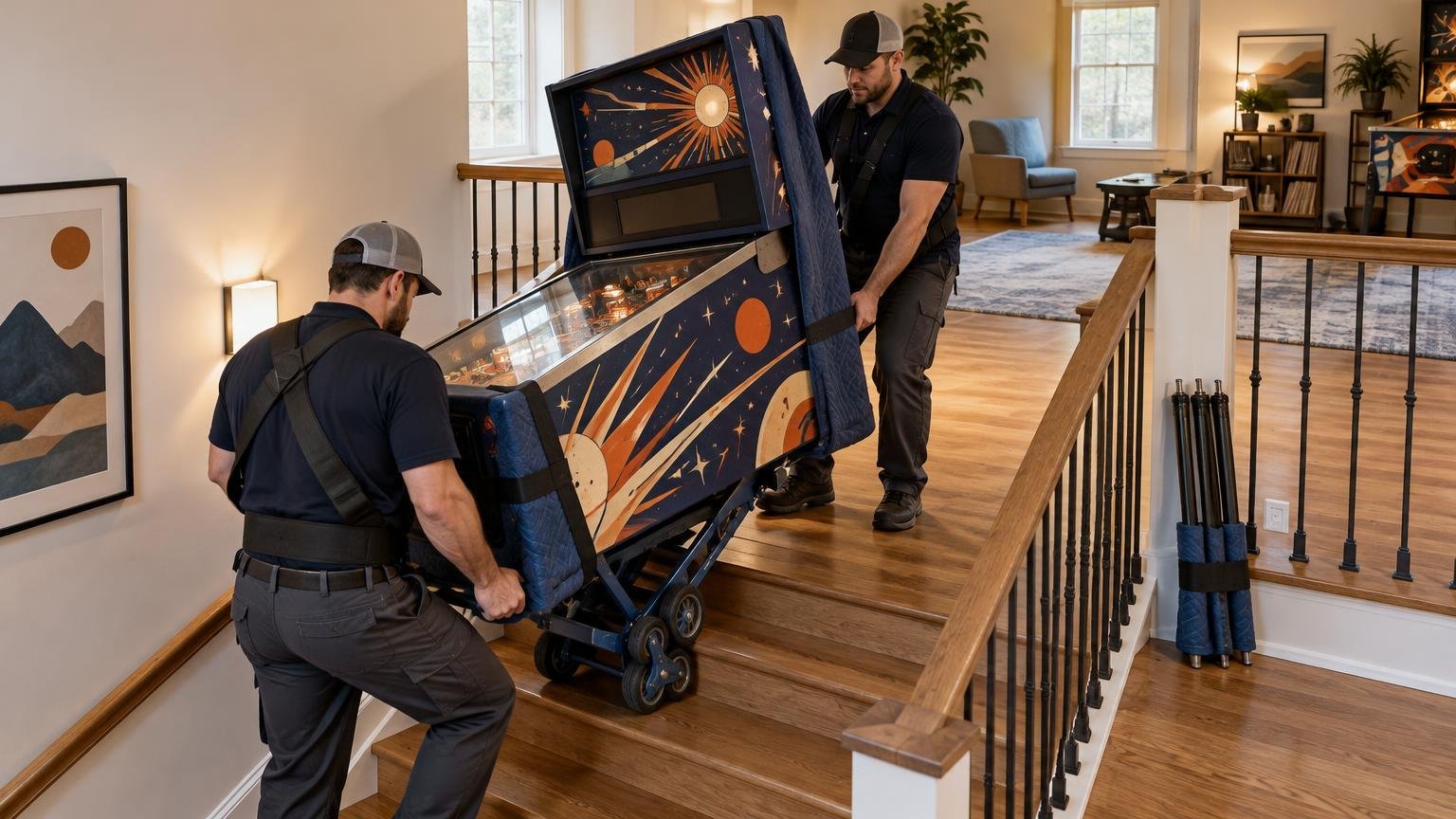
Putting a pinball machine upstairs can work, but the machine’s total weight is only one part of the decision. You also need to consider how that weight reaches the floor through four leg levelers, whether the complete delivery route is usable, and whether the final room has enough clearance for play and maintenance. Power, mechanical noise and the possibility of moving the machine again matter too.
Start with the exact machine rather than a generic online estimate. Full-size games vary substantially: Stern lists its Uncanny X-Men Pro at 210 pounds assembled, while Jersey Jack Pinball lists Harry Potter at 322 pounds without a topper and 325 pounds with one. That range is large enough to change both moving plans and structural questions.
Check the exact weight and transport dimensions
The game’s manual should be your primary planning document. Look for assembled weight, cabinet dimensions, backbox dimensions, electrical requirements and the manufacturer’s setup procedure. The cited Stern game measures 76 by 27.75 by 57 inches when assembled. The cited Jersey Jack game is approximately 29 inches wide and 57 inches deep, but both manufacturers specify room envelopes larger than the cabinet itself.
Transport dimensions matter more than parked dimensions while the machine is on the stairs. Stern documentation describes removing the legs and folding or securing the backbox for transport, but the correct procedure depends on the model. An older Stern manual also specifies at least two people for moving and maneuvering that game. Follow the manual for the machine you own and use experienced movers when stairs, tight turns or substantial lifting are involved.
Do not judge the floor with a simple pounds-per-square-foot calculation
The 2021 International Residential Code table lists minimum uniform live loads of 30 pounds per square foot for sleeping rooms and habitable attics, 40 pounds per square foot for other rooms, and both a 40-pound-per-square-foot uniform load and a 300-pound concentrated-load requirement for stairs. The full table is available in the International Residential Code building-planning chapter.
Those figures are design criteria, not a promise that any existing upstairs floor can accept a particular machine. Joist size, spacing, span, lumber properties, alterations, deterioration and deflection all affect floor performance. The American Wood Council span-table tutorial explains how these variables interact in wood-floor design.
A pinball machine also bears on four relatively small leg levelers. Dividing its weight by the cabinet footprint does not model those contact points, and comparing the machine’s total weight directly with a room’s live-load figure does not establish that the location is adequate. If the framing is unknown, the room has a long unsupported span, the floor already feels unusually flexible, or you are planning several machines together, ask a qualified structural professional to assess the actual floor.
Measure the complete route before delivery day
A doorway that fits the cabinet does not prove the machine can reach the room. Measure the route in the configuration that will actually be carried, including any packing or protective material. Community discussions repeatedly identify narrow stairs, right-angle turns and undersized landings as practical obstacles. Treat those reports as planning experience rather than technical specifications.
- Measure every exterior and interior door opening, including handles, trim and self-closing hardware.
- Record the clear stair width at handrails and other projections, not merely the wall-to-wall width.
- Check overhead clearance along the stair slope and at the top and bottom transitions.
- Measure landing depth and the turning space at every corner.
- Identify railings, doors or fixtures that could block rotation, but do not remove structural or safety components casually.
- Confirm where movers can stop, change grip and place the cabinet safely.
- Plan how the legs, backbox, balls and other secured or removed components will be handled under the machine’s manual.
Jersey Jack describes a company-specific white-glove service that can use a two- or three-person team for stair moves, illustrating why difficult routes may require more help than a normal ground-floor delivery. Verify what your seller or mover includes; never assume delivery automatically covers stairs, assembly or final leveling.
Leave room to play and service the machine
Once upstairs, the machine needs more than its cabinet footprint. Allow comfortable player space, a safe path around the game and access to the coin door, backbox and power connection. Glass removal and raising the playfield into a service position also require usable clearance. The broader home pinball space guide can help you plan the room envelope, while the home setup guide covers lighting, leveling and room choice.
Think about future service before placing the machine in a tight alcove. A location that looks tidy may become frustrating if every cleaning or switch inspection requires moving a 200- to 300-pound game. Keep manuals, keys and model-specific documentation accessible, and preserve a workable path for a technician.
Plan for power, sound and vibration
Electrical requirements differ by machine. Stern specifies 120 VAC, 60 Hz, 3 amps nominal and a 4.5-amp peak lasting less than 100 milliseconds for the cited Uncanny X-Men Pro. Jersey Jack publishes different figures for some of its games. Manufacturer documentation calls for a properly grounded outlet and warns against overloaded circuits. Check the exact manual instead of treating one game’s rating as universal.
An upstairs location can make sound more noticeable elsewhere in the house. Some modern games provide separate adjustments for music, effects or knocker volume, but lowering speaker volume does not eliminate flipper action, pop bumpers, ball impacts and cabinet vibration. Owners commonly report that these mechanical sounds can travel through a home, although those reports are subjective rather than standardized acoustic tests. The practical question is whether play sessions fit the household’s schedule and the rooms below or beside the machine. For mitigation ideas and warning signs, see the guide to pinball machine noise in a house.
Include maintenance in the upstairs plan
A home pinball machine needs recurring cleaning, inspection and leveling. Stern’s cited documentation calls for checks and cleaning monthly or every 500 games, with more extensive work at 5,000 games. Jersey Jack advises regular cleaning, debris removal, leveling and replacement of worn rubber parts. The exact schedule should follow the game’s manual and its actual condition; a lightly used home game and a busy event machine will not age at the same rate.
Owners can safely observe dirt, loose-looking parts, leveling and obvious changes in play with the machine powered off where appropriate. Electrical measurements, unfamiliar wiring, coil problems and mechanism repairs require the correct documentation and suitable skill. A machine that cannot be accessed safely for service is poorly placed even if it technically fits.
Make the decision before the machine arrives
If one of those checks produces uncertainty, solve it before delivery day. A structural assessment or professional stair move costs less trouble than discovering halfway up the stairs that the landing is too short—or after setup that the machine cannot be serviced where it stands.
References
- THE UNCANNY X-MEN
- # SPECIFICATIONS
- # POWER REQUIREMENTS
- CHAPTER 3 BUILDING PLANNING – 2021 INTERNATIONAL RESIDENTIAL CODE (IRC)
- Tutorial for Understanding Loads and Using Span Tables – American Wood Council
- pinball machine dimensions | All Pinball | Pinside.com
- Sonic Special Edition | Jersey Jack Pinball
- E:\SCHEMATC\CDR\s5c1234-65.cdr
- FAQ | Jersey Jack Pinball
- N5 Operation and Parts Manual
- Apartments and Pinball- Warn the neighbors? | All Pinball | Pinside.com
- How to Set Up – Stern Pinball