
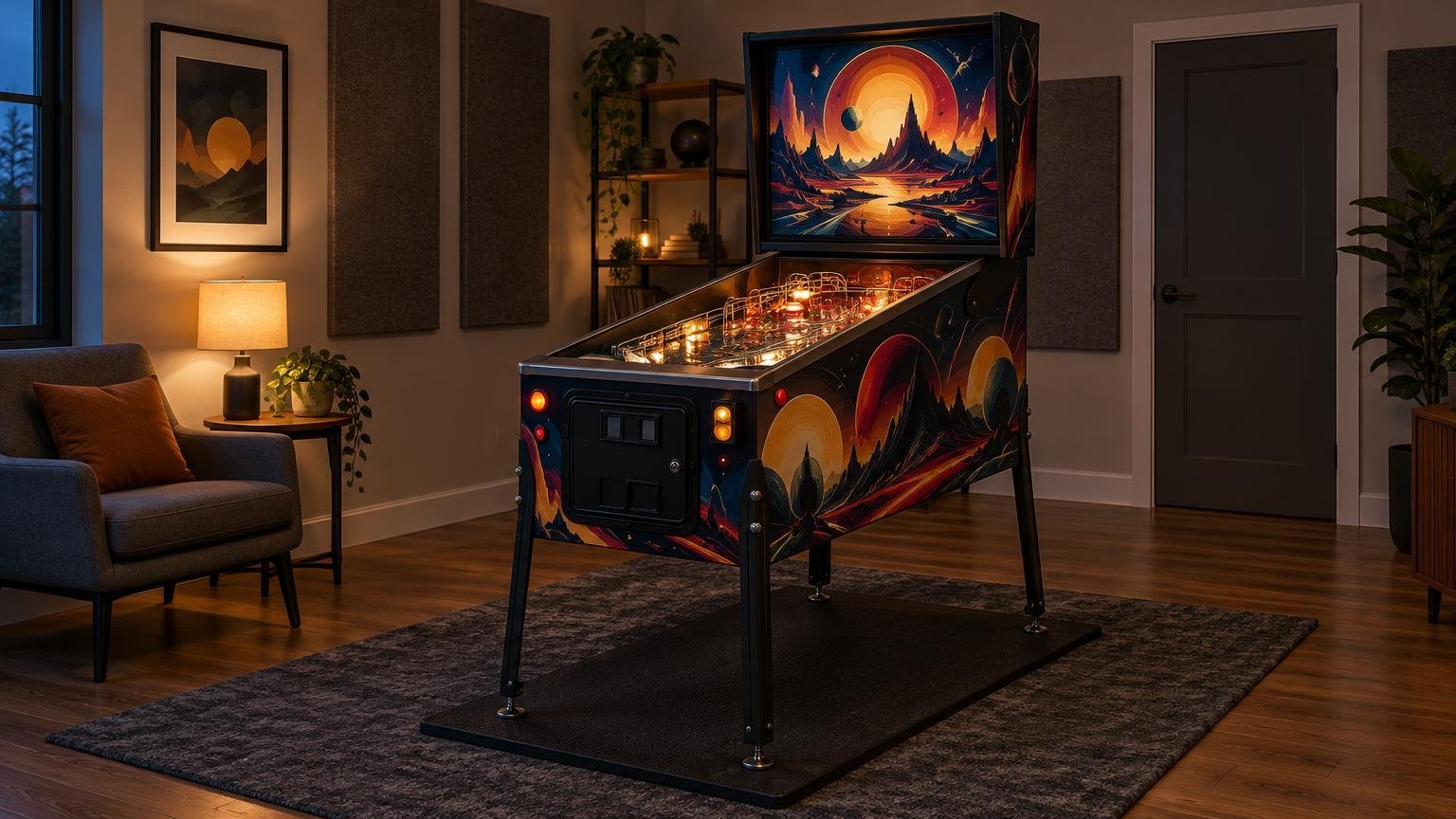
A pinball machine is too loud for a house when its soundtrack, mechanical impacts or vibration regularly disrupt people in nearby rooms—not when it crosses one universal sound level. Managing pinball machine noise at home therefore takes more than turning down the game volume. The room, floor, playing schedule and machine configuration can matter as much as the speaker setting.
The practical answer is to separate three different problems: sound traveling through the air, normal mechanical noise from gameplay and vibration entering the building. Lowering speaker volume helps with the first. It does little about flippers, pop bumpers, ball impacts or a shaker motor transferring energy into a wood floor.
What makes a pinball machine loud?
Pinball combines amplified audio with abrupt physical action. The sounds also have different characteristics, so a measure that works on one source may accomplish little against another.
| Noise source | What you hear or feel | Most useful first response |
|---|---|---|
| Cabinet and backbox speakers | Music, speech and sound effects | Reduce the game’s documented volume setting |
| Flippers, coils and ball impacts | Sharp clicks, knocks and repeated impacts | Choose a suitable room and limit late-night play |
| Shaker motor | Cabinet vibration and a low mechanical rumble | Check title-specific settings and address floor transmission |
| Knocker | A brief, forceful award knock | Look for a documented title-specific knocker setting |
| Woofer or external subwoofer | Bass that may remain noticeable beyond the game room | Lower bass or remove an optional external subwoofer |
| Loose or failing component | New buzzing, rattling or distorted sound | Document the symptom and inspect or service the machine |
Speakers and cabinet woofers
Speakers produce the part owners can usually control most easily: music, callouts and effects. Many machines provide volume controls, but the interface varies by platform and era. For example, Stern’s Star Wars: Fall of the Empire documentation assigns volume functions to service buttons, while the older Family Guy manual identifies a separate Volume Menu. Use the manual for the exact title, edition and current software rather than assuming another Stern—or another manufacturer’s game—works the same way.
An external powered subwoofer can make a game more disruptive even if the main volume seems modest. Low-frequency sound may be more apparent elsewhere in the building than it is beside the cabinet. If a subwoofer is optional, disconnecting it according to its instructions or lowering its own level is a straightforward comparison test. Do not improvise speaker wiring or change electrical loads to chase a quieter result.
Coils, flippers and ball impacts
A muted pinball machine is still mechanically active. Flipper coils fire, slingshots snap, pop bumpers cycle, targets take direct hits and the steel ball contacts guides, posts and cabinet assemblies. These short impacts can be more objectionable during quiet hours than a low, steady soundtrack.
Treat those sounds as a room-and-schedule issue, not an invitation to weaken the game. Stern’s Lord of the Rings documentation discusses coil-pulse adjustment in relation to solenoid feel and line-voltage conditions, not as a household quieting feature. Changing coil or voltage-related settings casually can affect gameplay and machine behavior. Follow the exact service documentation or leave that work to a qualified technician.
Shaker motors and knockers
A shaker motor is a distinct vibration-producing assembly rather than another speaker. Stern’s AC/DC Premium manual, for example, documents shaker hardware and connections on applicable machines. Whether a specific game lets you disable the shaker or alter its intensity depends on the title, hardware and software. Check before buying a shaker-equipped machine for an upstairs room, and verify the available settings before installing an aftermarket unit.
A knocker creates a deliberately sharp award sound. Some machines provide control over it: the Teenage Mutant Ninja Turtles manual lists a Knocker Volume adjustment. Older documentation, including Lord of the Rings, demonstrates that knocker options are not uniform across titles. A setting on one game should not be treated as a feature shared by every model.
Reducing pinball machine noise at home safely
Start with reversible changes that do not alter coil strength, wiring or normal safety systems. Make one change at a time, then listen from the room where disturbance matters. Standing beside the machine is a poor way to judge what a sleeping room, downstairs unit or shared hallway receives.
- Find the manual for the exact title and edition. Manufacturer support pages such as Stern’s game support resources are a better starting point than instructions recalled from a different machine.
- Set the documented game volume to the lowest level that still makes play enjoyable. If available, review title-specific controls for the knocker, shaker or bass.
- Play a short representative game while another person listens in the adjacent room, below the machine and near any shared wall.
- Repeat the test with optional vibration-heavy accessories disabled through documented settings, if the machine provides them.
- Set realistic playing hours based on the results rather than assuming a closed door solves the problem.
If you are still choosing a location, review the complete room—not just the empty patch where the cabinet fits. A good setup also needs a safe power connection, a level and stable floor, a workable transport route and enough clearance to remove the glass and raise the playfield. The home pinball room setup guide covers those wider placement decisions.
Rug, acoustic treatment or isolation pad?
These products solve different problems. Rugs, curtains and other absorptive materials can reduce reflected sound within a hard room. They may make the space less lively, but that does not mean a rug will stop a shaker motor or flipper impact from being noticed downstairs.
Vibration isolation addresses energy passing through a rigid path into the floor or another part of the structure. The CDC/NIOSH engineering-controls guidance distinguishes vibration isolation from sound absorption, recommends securing loose parts and reducing rigid vibration paths, and warns that incorrectly selected mounts can make vibration worse.
That distinction matters under a pinball machine. A generic soft pad is not automatically an effective isolator, and anything placed under the legs must preserve stability and leveling. Avoid improvised stacks, compressible materials that let the cabinet rock, or products that make the leg feet prone to slipping. If structure-borne vibration is the real problem, choose a purpose-appropriate, load-rated solution and recheck that the machine is stable and level afterward.
Choosing the least disruptive room
A ground-floor or basement room with fewer shared sleeping-room boundaries is often easier to live with than an upstairs bedroom, but every building behaves differently. Wood framing, concrete, wall connections and room furnishings all change what another person hears. The useful test is performed in the listener’s space, not at the flipper buttons.
Before settling on a location, compare two or three realistic positions if possible. Listen below the game and on the other side of shared walls. Try the machine at the volume and time of day you actually expect to use it. Moving a cabinet a short distance can change the result, but do not sacrifice service clearance, safe access or proper leveling simply to gain a minor acoustic improvement. The home pinball space guide can help account for operating and maintenance clearance.
Apartments, condos and late-night play
Apartment and townhouse suitability depends less on whether pinball is “generally loud” and more on floor transmission, shared surfaces and expectations. A machine without a shaker or external subwoofer can still produce repeated coil and ball impacts. Conversely, a well-placed machine played during agreed hours may be workable even when it is clearly audible inside its own room.
Check the lease, condo or HOA rules and any applicable local quiet-hour requirements. Occupational noise information is not a substitute: OSHA explains sound levels using logarithmic dBA measurements and provides workplace exposure guidance, but those limits are not household quiet-hour standards or local noise ordinances. A phone sound-meter reading also cannot capture every annoyance caused by brief impacts or vibration in another room.
The most useful plan is a real listening test followed by a playing window everyone understands. If nighttime play is important, accept that reducing the soundtrack cannot silence normal mechanisms. A digital or virtual pinball setup with headphones may suit that use better than attempting to make a physical game mechanically silent.
When noise may indicate a repair issue
Clicks, impacts and motor sounds are normal only when they match the machine’s usual operation. A new metallic rattle, persistent buzz, distorted speaker, scraping sound or suddenly harsher vibration deserves attention. It may indicate a loose fastener, vibrating panel, speaker problem, worn mechanism or accessory contacting something it should not.
With the machine powered off and unplugged, an owner can safely observe accessible external details: whether the cabinet is stable, whether a removable accessory is visibly loose and whether the noise appears only during one shot or feature. Do not reach into energized assemblies, alter fuses or wiring, or continue operating a machine that produces an electrical smell, smoke or signs of overheating.
Record the game title and edition, when the sound begins, which feature triggers it and whether it changes with speaker volume. A short video from both beside the machine and the affected room can be more useful than describing the problem as simply “loud.” The pre-service pinball checklist provides additional observations to make before requesting help.
The practical threshold for “too loud”
A machine is too loud for its current setup when normal play cannot coexist with the room, building or household schedule. First lower documented audio settings. Then determine whether the remaining disturbance is mechanical impact, bass or structure-borne vibration. Use room furnishings for reflected sound, carefully selected isolation for transmitted vibration and playing hours for the mechanical noise that cannot reasonably be removed.
If a sound is new, uneven or accompanied by abnormal operation, treat it as a possible maintenance problem rather than trying to cover it with padding. Rock Custom Pinball states that its Utah repair and troubleshooting inquiries should include the game title, a clear description and photos or video when useful. Providing those details helps separate an ordinary home-noise concern from a machine that needs service.
Frequently Asked Questions
Are pinball machines too loud for apartments, condos or townhouses?
It depends on floor transmission, shared surfaces, placement and playing hours. Even with low speaker volume, coils, ball impacts and shaker vibration may be noticeable in nearby units. Test from the affected rooms and follow applicable lease, HOA and quiet-hour rules.
Why is a pinball machine still loud after the speaker volume is lowered?
Lowering the volume affects music, speech and sound effects, but not normal mechanical sounds from flippers, coils, bumpers and ball impacts. It also may not resolve vibration from a shaker motor or low-frequency output from a subwoofer.
Should coil power be reduced to make a pinball machine quieter?
Not as a general noise-control measure. Coil-pulse adjustments can affect gameplay and machine behavior, and supplied documentation discusses them in relation to solenoid feel and line-voltage conditions rather than household quieting. Follow the exact service documentation or consult a qualified technician.
Will a rug make a pinball machine quieter downstairs?
A rug may reduce reflected sound within the room, but it is not the same as vibration isolation. Structure-borne vibration requires a purpose-appropriate solution that preserves the machine’s stability and leveling; incorrectly selected mounts can worsen vibration.
Can a pinball knocker or shaker motor be turned down or disabled?
Controls vary by title, hardware and software. Some games document knocker adjustments, while shaker options are machine-specific. Check the manual for the exact title, edition and installed software rather than assuming the setting is universal.
References
- Z3 Operation and Parts Manual
- E:\SCHEMATC\CDR\s5c1234-65.cdr
- Standard Adjustments Continued.
- AC/DC Premium Operation and Parts Manual
- Q5 Operation and Parts Manual
- Support – Stern Pinball
- Implement Engineering Controls | Noise and Hearing Loss | CDC
- Occupational Noise Exposure – Overview | Occupational Safety and Health Administration
- Contact – Rock Custom Pinball Rentals