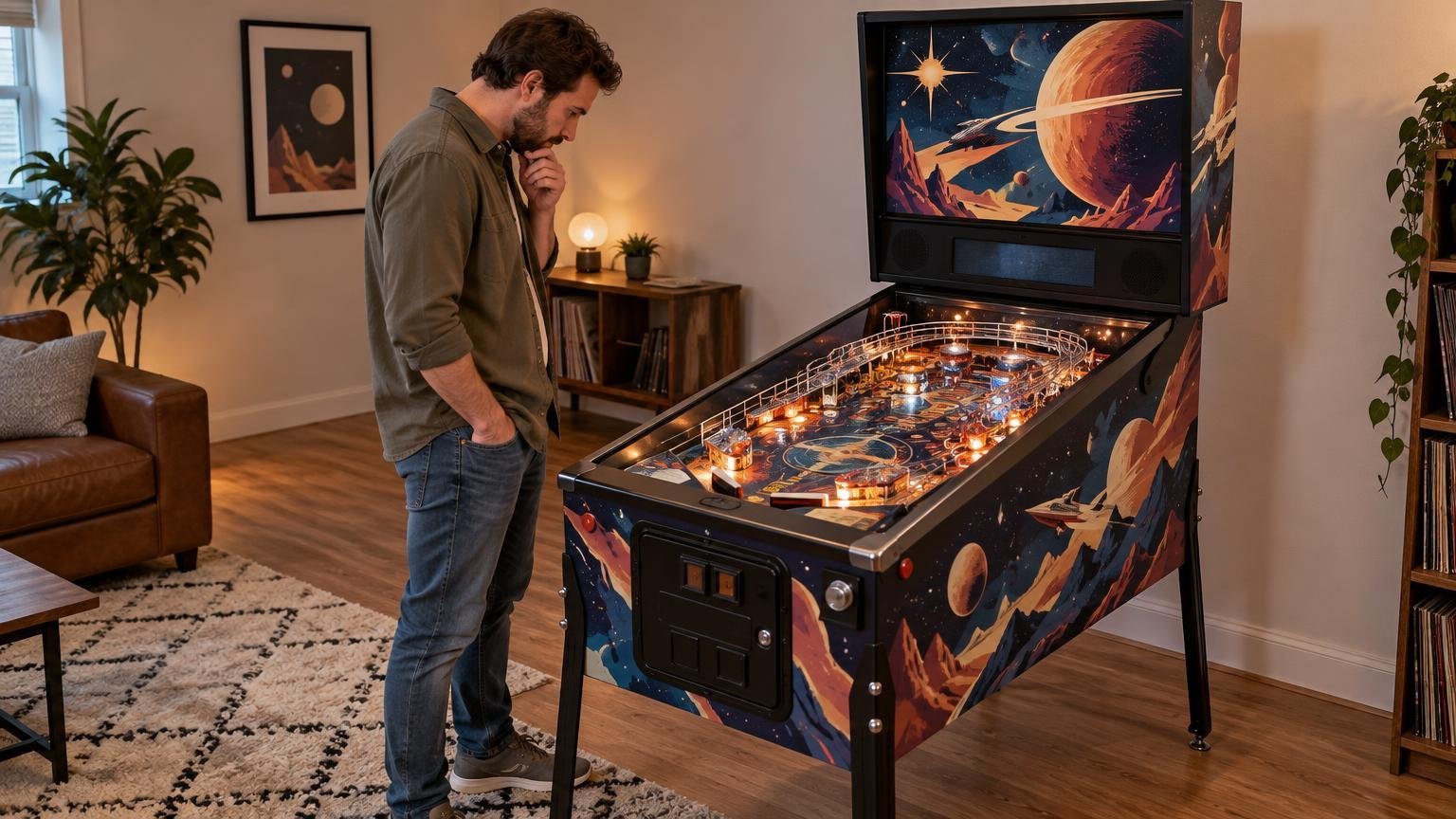
For most home buyers, the ruleset should matter more than the theme—but only after the theme clears a basic enthusiasm test. Theme gets you interested in a machine. Shots, objectives, scoring and progression determine whether you still want to play it after the artwork and callouts are familiar.
That does not make theme superficial. A machine sharing your favorite film, band or character can become the centerpiece of a room and attract family members who would otherwise ignore pinball. The mistake is treating theme as the entire buying decision, especially when a machine will be your only game.
Theme gets attention; rules earn repeat plays
Theme includes more than cabinet art. It affects music, speech, display content, toys and the overall mood of every game. If those elements irritate you, a sophisticated ruleset will not rescue the purchase. You will hear and see them constantly.
The ruleset governs what the machine asks you to do and how it rewards improvement. Relevant questions include whether progress carries through a long game, whether different modes encourage different shots, how clearly the game communicates objectives, and whether scoring gives you meaningful decisions instead of one obviously dominant strategy.
Shot feel belongs in the decision too. Two machines can have equally deep code but feel completely different because of ramp geometry, flipper layout, ball speed and risk around major shots. A rules explanation cannot tell you whether you enjoy making those shots.
| Buyer or setting | Give more weight to | Why |
|---|---|---|
| Only machine in the house | Ruleset and shot variety | The game must support repeated play without another machine providing contrast. |
| Shared family or guest game | Accessible theme and readable goals | Recognition and immediate feedback can help occasional players engage. |
| Experienced competitive player | Scoring depth and decision-making | Strategic alternatives generally matter more over many games. |
| Collector or themed room | Theme, artwork and edition details | Presentation may be a central part of the ownership goal. |
| Short-term ownership or frequent trading | Condition and market fit | Purchase price, condition and resale practicality may outweigh either preference. |
Do not compare themes until you normalize the edition
A title is not always one fixed game. Pro, Premium, Limited Edition and other configurations can differ in mechanisms, presentation and included accessories. Those differences may alter both gameplay and ownership burden.
Stern’s official Jurassic Park feature information, for example, says all versions have three flippers, four ramps, a spinner and a Newton-ball vehicle target. Premium and LE machines add an animatronic T. Rex and an interactive Raptor Pen lock with a motorized gate. The LE also includes collector-oriented additions such as exclusive artwork, a numbered plaque, anti-reflection glass and a shaker motor. Some differences affect ball movement; others mainly affect presentation and collectibility.
Never assume an LE label has the same practical meaning across different titles. Check the manufacturer’s feature list for the exact game and edition. Then ask whether each added mechanism improves play enough to justify its price and potential service demands. A cosmetic package can be desirable, but it should not be mistaken for a deeper ruleset.
Condition can outweigh both theme and rules
A used copy of your dream title can be the worse purchase if it has substantial wear, intermittent faults or undocumented work. The Pinball Price Guide condition framework separates cabinet and hardware condition from the playfield, backglass, electronics and overall playability. That is more useful than accepting a single adjective such as “excellent.”
Inspect photographs critically, but do not treat them as a complete evaluation. The Museum of the Game’s pinball buying guidance notes that photographs can miss light burns, mildew and general wear, while cosmetic and mechanical condition both affect price. Ask for clear images of the playfield wear areas, cabinet sides, backbox, boards and display, plus a video showing a complete startup and gameplay.
Marketplace labels such as home use, restored or good condition are seller descriptions rather than universal standards. Compare the evidence behind the label. For a title-specific example of this inspection mindset, see the guide to checking an Addams Family machine on a marketplace.
Compare price, code and serviceability separately
Price should be normalized for edition, physical condition, included accessories, delivery and any warranty or support. An asking price is not the same thing as a completed sale. Pinside says its pricing database weighs verified sales more heavily than listing prices, while also warning that anomalies can occur and that the cited valuation method did not account for machine condition. Use pricing databases and archived listings as context, not as an appraisal of the machine in front of you.
Code maturity deserves its own check on modern games. Look for current release notes, update history and unresolved behavior relevant to the title. Stern provides game code, manuals, service bulletins, system documentation and technical support resources, while Jersey Jack’s Guns N’ Roses quick-start guide similarly directs owners to check for current software and update instructions. Documentation does not prove a game is easy to repair or that every required part is available, but its absence can make ownership harder.
Serviceability also includes physical access, mechanism complexity and local repair options. An elaborate toy may improve gameplay while introducing motors, switches or moving assemblies that eventually need adjustment. That is not a reason to reject every complex machine; it is a reason to understand what the higher trim adds before paying for it.
Account for the room, not just the game
A compelling theme and deep rules cannot fix a bad installation. Before buying, confirm the transport route, door and stair access, floor space, power, sound tolerance and lighting. Leave enough clearance to remove the glass, raise the playfield and reach the cabinet for service. The home pinball space guide covers these practical clearances, while the room setup guide helps identify problems before delivery.
Consider who will hear and play the machine. A rules-heavy title may be ideal for a dedicated player but confusing to guests. A music machine can be irresistible to one household member and exhausting to another. Volume controls help, but they do not change the basic character of the audio package.
Use a two-stage buying test
First, eliminate machines with themes you actively dislike, shots you do not enjoy, or ownership requirements your home cannot support. Second, compare the survivors using the same criteria: exact edition, condition, total delivered price, code status, service documentation and expected maintenance.
If possible, play several games rather than making a decision from one unusually good or bad ball. Notice whether you understand what the game wants, whether missed shots feel fair, whether progress makes you want another attempt, and whether the audio remains enjoyable. For a broader comparison framework, use the complete home pinball buyer’s guide.
The best default is simple: choose a theme you enjoy and then buy the strongest rules-and-shot package available within your budget, space and maintenance tolerance. Let theme break a close tie. Let ruleset win when you are choosing the machine expected to carry hundreds of repeat plays. And let condition overrule both when the specific machine is not sound enough to justify its price.
Frequently Asked Questions
Should a first-time pinball buyer prioritize theme or rules?
Prioritize rules and shot feel once the theme clears a basic enthusiasm test. For an only machine, replayable objectives, satisfying shots and meaningful scoring choices usually matter more than licensed artwork alone.
How should I compare Pro, Premium and Limited Edition machines?
Use the manufacturer’s feature list for the exact title. Separate mechanisms that change ball movement or gameplay from artwork, trim, glass and collector extras, then decide whether added complexity justifies the price and service burden.
Can condition matter more than getting my favorite title?
Yes. Significant wear, intermittent faults or undocumented work can make a dream title the worse purchase. Evaluate the cabinet, playfield, backglass, electronics and playability separately, because photographs and broad seller labels can hide important problems.
How can I judge whether a used pinball machine is fairly priced?
Compare the exact edition, condition, accessories, delivery cost and support included. Verified sales and archived listings provide market context, but they do not appraise the specific machine in front of you.
What home-use factors should I check before buying?
Confirm the transport path, doors and stairs, floor space, power, lighting and acceptable sound level. Leave enough clearance to remove the glass, raise the playfield and reach the cabinet for service.
References
- Jurassic Park – Stern Pinball
- Determine Condition | Pinball Price Guide
- Videogame and Pinball Buying and Selling Tips | Museum of the Game
- Pinside Collection Editor v2, pricing estimates and graphs | Website announcements | Pinside.com
- Pinside Marketplace » Ads archive | Pinside Market
- Support – Stern Pinball
- spike-manual-new-v2.indd
- Important Game Information
- Rock Custom Pinball Rentals