
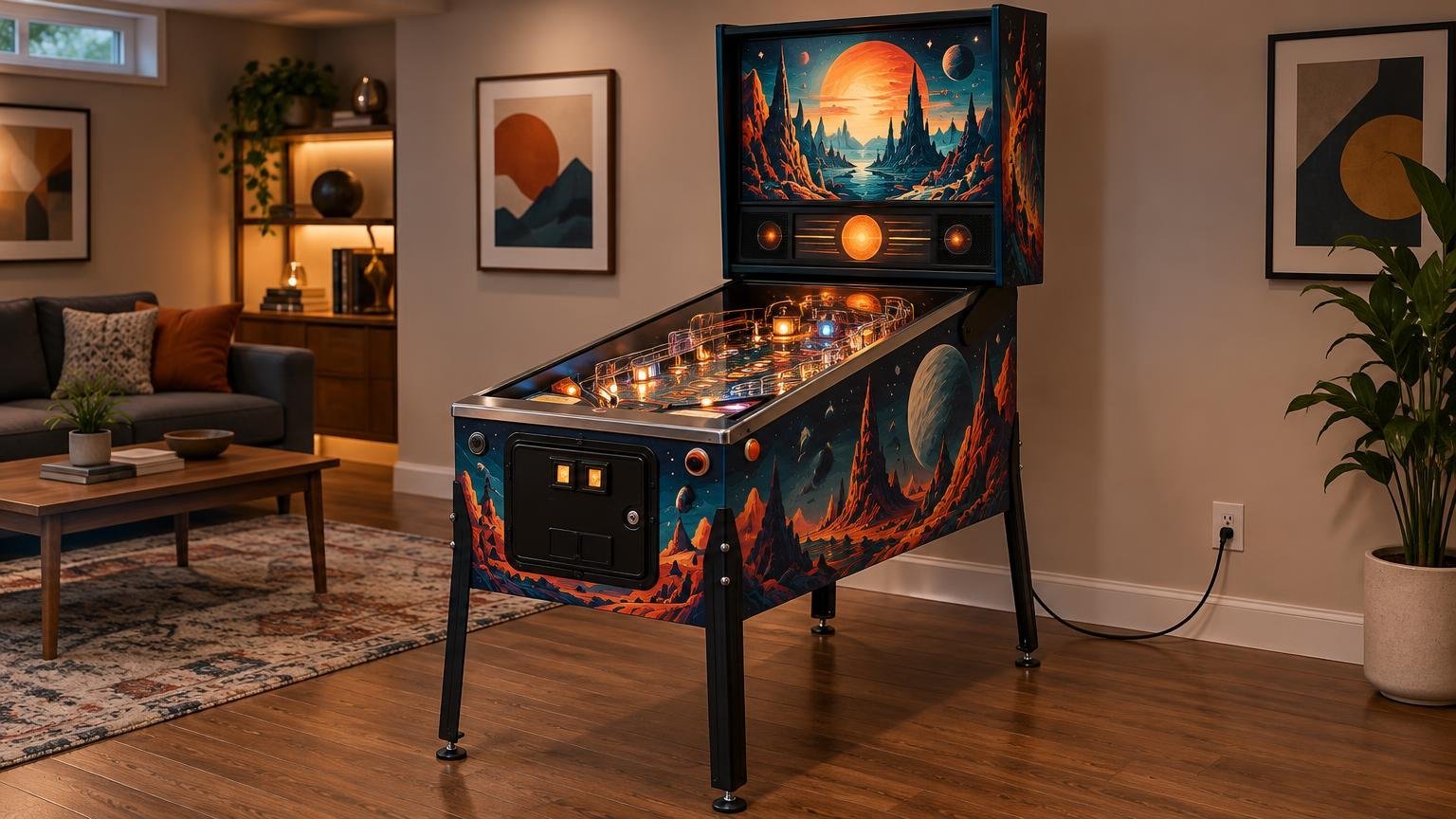
A modern pinball machine may draw around 70 watts while sitting in attract mode and several hundred watts during active operation, but there is no single wattage that applies to every game. Coils, motors, lighting, displays, sound and power-supply design all affect demand. More importantly, the number on a manual or electrical label may describe a planning requirement rather than continuous consumption.
For a concrete example, Stern’s Uncanny X-Men Pro manual lists 70 watts in attract mode, 360 watts at nominal operation and a 540-watt peak lasting less than 100 milliseconds. Those are useful figures for understanding one contemporary machine, not a universal specification for every modern or classic game. Stern’s official Uncanny X-Men Pro manual provides the model-specific details.
Watts, amps and kilowatt-hours answer different questions
Watts describe the power a machine is drawing at a particular operating condition. Amps help determine how much electrical load is being placed on a household circuit. Kilowatt-hours measure energy over time and are what an electric utility generally uses to calculate the energy portion of a bill.
These numbers should not be treated as interchangeable. Jersey Jack Pinball publishes a domestic power requirement of 120 volts and 8 amps, for example, but that does not mean one of its machines continuously draws 960 watts. It is a supply requirement, not a measurement of typical energy consumption.
The basic cost calculation is straightforward: cost equals watts divided by 1,000, multiplied by operating hours, multiplied by the electricity price per kilowatt-hour. Current regional and national price data are available from the U.S. Energy Information Administration, but the rate on the homeowner’s utility bill is the right figure for a personal estimate.
Attract mode can matter more than a short playing session
The greatest variable may be how long the machine remains switched on. A lower attract-mode draw operating around the clock can consume more monthly energy than two hours of higher-power play followed by a complete shutdown.
| Usage pattern | Calculated monthly energy | Cost at a sample $0.18/kWh |
|---|---|---|
| 70 W attract mode, 24 hours per day | 50.4 kWh | About $9.07 |
| 360 W nominal operation, 2 hours per day; off otherwise | 21.6 kWh | About $3.89 |
| 70 W for 22 hours plus 360 W for 2 hours per day | 67.8 kWh | About $12.20 |
These 30-day examples use the published Uncanny X-Men Pro figures and a sample electricity rate. They illustrate the arithmetic rather than predict the bill for another machine. Actual gameplay draw rises and falls as coils, motors, lights and sound operate, while an older game or a feature-heavy machine may behave differently.
What drives pinball machine power consumption?
A pinball machine is a collection of intermittent and continuous loads. Displays, computers, power supplies and some lighting operate for long periods. Flipper coils, pop bumpers, kickers, magnets, shakers and motors create short changes during play. Volume, lighting behavior, installed accessories and software-controlled features can also change the operating pattern.
- Operating mode: A powered machine in attract mode still consumes energy even when nobody is playing.
- Mechanical activity: Coils and motors create brief higher-demand events during active play.
- Machine generation and design: Lighting technology, displays, power supplies and mechanical features differ substantially among eras and models.
- Accessories and modifications: Toppers, shaker motors, additional lighting and other powered mods can add load.
- Operating time: Hours switched on usually matter more to the monthly bill than a millisecond-scale peak.
The 540-watt peak in Stern’s example lasts for less than 100 milliseconds, so it contributes very little to monthly kilowatt-hours. It still matters to the manufacturer’s electrical design and circuit-planning guidance. A peak rating, nominal operating figure and measured average consumption each answer a different question.
Plan the circuit, not just the outlet
An available receptacle does not guarantee abundant circuit capacity. Other outlets, lights or appliances may share the same breaker. Stern illustrates circuit planning for the example game by dividing a 15-amp circuit by its 3-amp nominal current, producing five games. That is a model-specific illustration, not permission to place five arbitrary machines on every 15-amp household circuit. Existing loads, wiring, breaker behavior and the requirements of each machine still matter.
For one machine, an owner can safely inspect the power cord and plug for visible damage, identify what else loses power when the circuit breaker is switched off, and check the machine manual for its stated requirements. Repeated breaker trips, warm or damaged receptacles, buzzing, scorch marks or unexplained resets call for qualified service rather than a larger extension cord or repeated breaker resets. If the machine itself restarts during demanding moments, use a structured guide to pinball resets during play instead of assuming the household circuit is the only possible cause.
Permanent placement near a suitable wall receptacle is preferable to routine dependence on an extension cord. When temporary cord use is unavoidable, the U.S. Consumer Product Safety Commission’s extension-cord guidance says connected wattage must remain within the cord’s rating and warns against running cords beneath furniture, rugs or carpeting.
Power is only one part of household fit
A good pinball location also needs enough physical and service clearance. Stern lists the Uncanny X-Men Pro at 27.75 inches wide and 57 inches deep in use, but recommends a per-game room area at least 36 inches wide and 84 inches deep. That extra space matters because an owner needs room to stand, remove the glass and access the playfield. The machine’s listed assembled weight is 210 pounds.
Other machines can be considerably heavier or wider. Jersey Jack lists headline dimensions including a 29-inch-wide backbox and a weight of 325 pounds. Measure the entire transport path, including doors, corners, stairs and ceiling height, before delivery. Our guides to setting up a pinball machine at home and planning for a pinball machine upstairs cover the room and moving questions in greater depth.
Noise is another practical limit. Cabinet volume can be adjusted, but flippers, pop bumpers, ball impacts and mechanical assemblies remain audible. Manufacturer documentation reviewed for this example provides adjustable volume controls but no household sound-pressure rating, so room location and playing hours deserve more attention than an unsupported decibel estimate.
Maintenance and modifications can change the planning question
Routine maintenance is mainly about reliable operation rather than reducing the utility bill. Stern recommends maintenance monthly or every 500 games, whichever comes first, including checks of lights, loose parts, rubbers, switches, wiring, level and pinballs, along with playfield and glass cleaning. A practical home pinball cleaning schedule can help separate ordinary care from repairs that require deeper access or technical skill.
Treat powered modifications as electrical changes, even when they look decorative. Confirm compatibility, current draw, connector type, fuse requirements, heat, wire routing and warranty implications before installation. A reversible lighting kit that blocks service access or overloads an accessory connector is not automatically an ownership improvement.
The practical answer for a home owner
Start with the exact machine manual, then estimate energy from its attract and operating figures. Use the local utility rate and realistic operating hours. If accuracy matters, measure energy at the plug with properly rated equipment. For circuit capacity, multiple machines or any sign of heat, damage or recurring trips, have a qualified electrician evaluate the installation.
For most households, operating time is the easiest part to control. Switching the game off when it will not be used prevents attract mode from quietly becoming the largest part of its monthly energy consumption. The final room choice should balance that electrical plan with access, weight, service clearance and noise—the factors most likely to determine whether a pinball machine fits comfortably into daily home life.
Frequently Asked Questions
How many watts does a pinball machine use?
It depends on the machine and operating mode. Stern lists the Uncanny X-Men Pro at 70 watts in attract mode, 360 watts at nominal operation and a 540-watt peak lasting less than 100 milliseconds. These are model-specific figures, not universal pinball ratings.
How do I estimate the monthly electricity cost?
Divide watts by 1,000, multiply by the hours used, then multiply by your electricity rate per kilowatt-hour. Use realistic attract-mode and playing hours rather than treating the peak rating as continuous demand.
Should I switch off my pinball machine when I am not playing?
Switching it off prevents attract mode from adding hours of steady consumption. For many households, controlling operating time will matter more to the monthly bill than brief power peaks during play.
Can one household circuit support multiple pinball machines?
Possibly, but count every load sharing the circuit and check each machine’s requirements. Stern’s five-game example is based on one model’s 3-amp nominal current and a 15-amp circuit; it is not a blanket rule for arbitrary machines or household wiring.
Is it safe to power a pinball machine with an extension cord?
A suitable wall receptacle is preferable for permanent placement. If temporary extension-cord use is unavoidable, keep the connected wattage within the cord’s rating and never route the cord beneath furniture, rugs or carpeting.