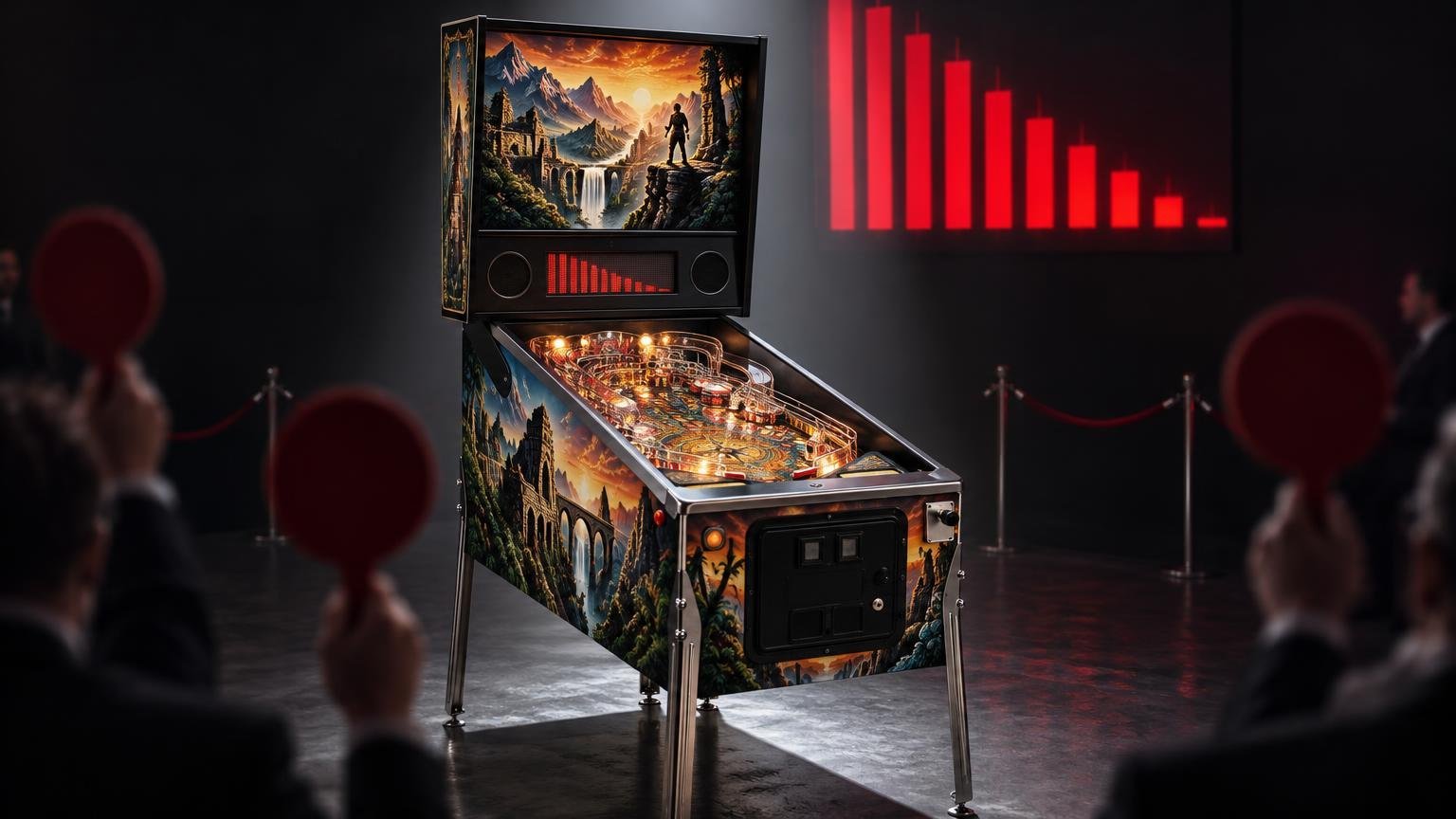
Flip N Out's handling of its Goonies Super Limited Edition allocation was an ugly exercise in monetizing collector anxiety. The opening offer was not simply expensive. It paired a $49,999 historical asking price with a planned series of reductions, a first-come process and the constant possibility that another wealthy collector might take the machine first. That is a pressure system, not a normal invitation to consider whether a pinball machine is worth buying.
Nobody has to buy a luxury pinball machine, of course. A seller can ask an absurd price, and a buyer can refuse it. But that basic freedom does not settle the ethical question. Pinball communities run on enthusiasm, shared knowledge and dream themes. Turning that enthusiasm into a countdown designed to discover one buyer's maximum pain threshold deserves direct criticism.
The offer was built around pressure
Before the sale, a Pinside post attributed to Zach Meny and Flip N Out said the dealer would gather an interest list and email its price at 10 a.m. Central on November 18, 2026. The process would be first come, first served. If machines remained after 24 hours, the price would drop and another offer would follow, repeating until the allocations were spoken for. The post estimated an SLE market range of $20,000 to $50,000, said the starting price would reflect the high end and reported that Spooky had encouraged dealers to sell at market price. Read the original Flip N Out post on Pinside.
According to This Week in Pinball's account of the offer, the November 18 email asked $49,999 before shipping and state sales tax. Later Pinside posts reported a revised offer of $44,999 plus tax. Neither figure proves that a machine sold, establishes Flip N Out's costs or reveals its profit. The accessible Flip N Out Spooky inventory page also showed no public Goonies listing during a November 23 check, so it did not confirm current availability, sell-through or a current asking price.
Those limits matter, but they do not rescue the sales method. The documented opening price and member-reported reduction show the buyer experience: decide now at an extraordinary number, or wait while wondering whether somebody with a larger bank account will end the opportunity. One forum member explicitly described that concern after the reported $44,999 email. The seller had created a process in which waiting for a less punishing price also meant risking the allocation.
Scarcity became the product
Spooky announced The Goonies on November 13, 2026, with a $10,999 Collector's Edition limited to 1,299 units and an 85-machine numbered SLE run. Thirty SLEs were reserved for a $14,999 drawing among eligible CE buyers. The remaining 55 were described as allocations for dealers and friends or family. If all 1,299 CE buyers had remained eligible, the drawing odds would have been about 2.31 percent. Kineticist's report on the Goonies editions and drawing documents that structure.
The SLE included collector treatments such as alternate artwork and trim, gold armor, an aqua playfield treatment, a mirrored backglass, a different topper hat, a Butter Cabinet, an alternate cave-rock sculpt and a signed and numbered apron magnet. Its underlying game configuration was the CE's configuration. These additions may be desirable, but the offer was fundamentally selling rarity and presentation rather than an entirely different game.
That distinction makes the price gaps hard to ignore. The $49,999 offer was $35,000 above the $14,999 drawing price and $39,000 above the CE price. The later member-reported $44,999 offer was respectively $30,000 and $34,000 higher. Those are differences between customer offers, not known dealer margins. Even with that qualification, they show how much money the scarcity story was being asked to carry.
Spooky's Lukas Kastner described the SLE as a celebration and invited buyers with the means to make dealers an offer based on what the machine was worth to them. That rhetoric sounds pleasantly open until the buyer is placed inside a staged reduction process. “What is it worth to you?” becomes “How much will you pay to stop worrying that somebody else gets it?”
A willing buyer does not make the tactic admirable
The predictable defense is that market price is whatever a willing buyer will pay. Fine. That can describe a transaction. It cannot pronounce the transaction tasteful, healthy for the hobby or respectful of customers. Markets contain pressure tactics, information gaps and emotional decisions every day. Pinball does not become exempt because the cabinet has a pirate ship on it.
This Week in Pinball called the episode “whale hunting,” an editorial label that fits the structure. The process did not begin with a stable price tied to specified costs or features. It began near the top of an estimated range and searched downward for the first collector wealthy, impatient or anxious enough to accept it. Community members responded with terms including “scummy” and “the scalper.” Those are reactions rather than established facts, but the anger was not mysterious.
There is a legitimate discussion to have about dealer inventory risk. Jason Grindle of Classic Game Rooms—not Meny—was quoted by This Week in Pinball arguing that occasional large gains can offset potential losses on unsold machines, citing Toy Story and Ultraman inventory as examples. That explains one dealer's economic defense. It does not mean every scarcity premium is beyond criticism, and it does not establish Flip N Out's costs or losses on this allocation.
Dealers deserve sustainable margins. Buyers deserve to be treated as customers rather than targets whose attachment to a childhood movie can be converted into a five-figure panic premium. Both statements can be true without performing advanced market theology over Sloth and a Butter Cabinet.
Set the boundary before the email arrives
A collector facing an offer like this should set an all-in ceiling before joining an interest list. Include the machine, tax, shipping, setup and any work required to get it safely into the home. Then divide the decision into two questions: what is the underlying game worth to you, and how much extra are you knowingly assigning to cosmetic treatments, numbering and rarity?
For the Goonies SLE, the $10,999 CE and $14,999 drawing price provide concrete historical reference points. They do not dictate what every dealer allocation must cost, but they expose the scale of the premium. A buyer considering $44,999 would need to decide that scarcity and collector treatments alone were worth roughly $30,000 more than the drawing offer. At $49,999, that gap was $35,000. If you cannot say calmly why those extras are worth that amount to you, your boundary has already been crossed.
Pinball enthusiasm deserves better
The Goonies is precisely the sort of theme that can bypass a collector's normal restraint. The long anticipation around the title, including the earlier Goonies pinball rumors, made that emotional demand unusually strong. A responsible seller can profit from enthusiasm without constructing a descending-price game around fear of losing access.
Flip N Out's documented $49,999 opening offer and staged-reduction plan treated scarcity as leverage against the very collectors who made the release valuable. Whether somebody eventually paid that amount is beside the point. A completed sale would prove that the tactic found a buyer, not that the tactic was decent. Set a hard boundary, value the machine rather than the countdown, and let an overpriced allocation become someone else's problem.
References
- Flip N Out Pinball: Fallout Tutorial (page 26) | Pinside Forum
- Whale Hunt
- The Goonies Hype Thread Spooky Pinball (page 122) | Pinside Forum
- Spooky Pinball | Flip N Out Pinball
- The Goonies Pinball: Spooky's Pricing, SLE Drawing & Details | Kineticist
- The Goonies Hype Thread Spooky Pinball (page 111) | Pinside Forum