
TLDR
- Twilight Zone pinball is one of the defining machines of the 1990s.
- It took the Rod Serling TV license and turned it into a packed, ambitious widebody full of toys, modes, and strange ideas.
- The clock, Powerball, gumball machine, and magnetic mini-playfield gave it a personality that still stands out.
- It is not just famous because it is complicated. It is famous because the complexity usually serves the theme.
This post helps pinball players, collectors, and curious buyers understand the history of Twilight Zone pinball by explaining where it came from, what made it different, and why it still matters, so they can better appreciate one of the hobby’s most iconic machines.
Some pinball machines are popular for a few years and then settle into “good old game” status. Twilight Zone never really did that. It has stayed in the conversation because it feels like an event. You walk up to it and immediately see that this is not a normal layout. There is a working clock. There is a gumball machine on the playfield. There is a ceramic ball that behaves differently from the steel ones. And there is a mini-playfield where the “flippers” are actually magnets.
That is the short version of the Twilight Zone pinball history. The longer version is even better, because this was not just a gimmick-heavy machine thrown together to impress people on location. It was the result of a design team swinging big in the early 1990s, right after The Addams Family became a monster hit. And unlike a lot of “more is more” designs, this one actually had a point of view.
Where Twilight Zone Pinball Came From
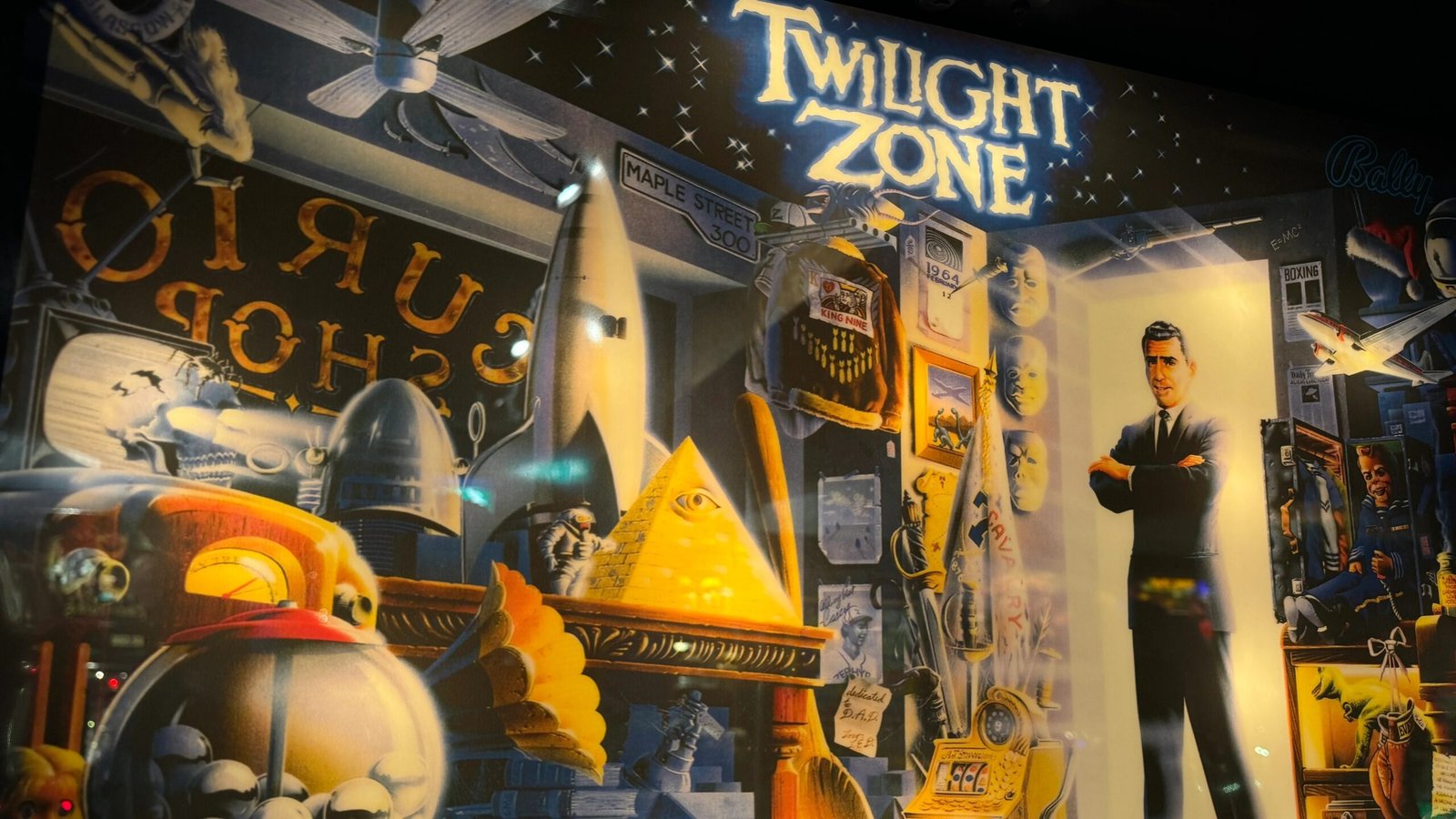
The machine was built around Rod Serling’s original The Twilight Zone, the landmark CBS anthology series that ran from 1959 to 1964. That show worked because it mixed science fiction, suspense, morality plays, irony, and a steady sense that ordinary reality could suddenly tilt sideways. That is exactly the mood the pinball machine was trying to capture.
And this is what makes the license fit so well. Some licensed games feel like a theme pasted on top of a layout. Twilight Zone feels like the design team asked a better question: what would a pinball machine look like if it actually tried to behave like an episode of the show?
The answer was a 1993 Bally release designed by Pat Lawlor, with software by Larry DeMar and Ted Estes, art by John Youssi, mechanics by John Krutsch, music by Chris Granner, and callouts by Tim Kitzrow doing the voice of Rod Serling. It was manufactured by Midway under the Bally label, and it became the first game in the SuperPin widebody line. That matters because Twilight Zone did not just arrive as another early-90s hit. It arrived as a statement piece.
Lawlor already had a reputation for making games that felt built around identity rather than just features. FunHouse had Rudy. Whirlwind had the fan and weather chaos. The Addams Family had unmistakable license integration. But Twilight Zone pushed that design philosophy further. It gave Lawlor and team more room, literally and creatively, and they used it.
Why The Design Felt So Different
A lot of old pinball legends sound exaggerated when you revisit them. Twilight Zone is one of the few that still feels almost overstuffed in the best way.
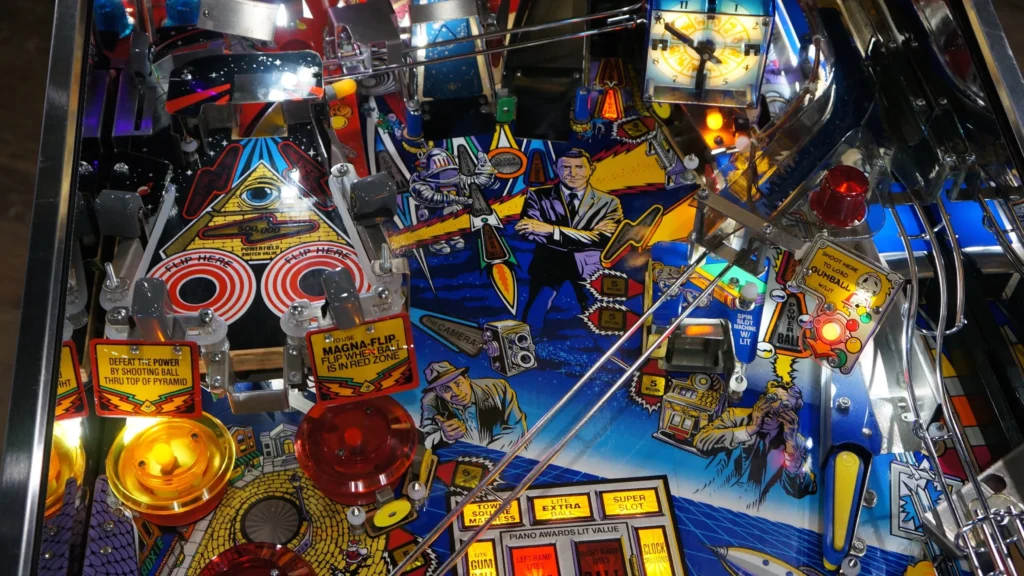
The machine has four flippers, two ramps, a real working gumball machine, a mechanical clock, and a mini-playfield called the Powerfield. The Powerfield uses magnets instead of standard flippers, so when players talk about “Magna-Flips,” they are talking about one of the most memorable little weirdos in all of pinball. The machine also has the Powerball, a white ceramic ball that is lighter than a steel pinball and not affected by the game’s magnets.
That last detail is a huge part of why the game still feels alive. A lot of pinball “special balls” are just novelty. The Powerball changes the rhythm of the game. It is faster, less stable, and more chaotic in a way that actually matters. Suddenly the same shots do not feel quite the same. The player has to adjust. The machine gets to surprise you.
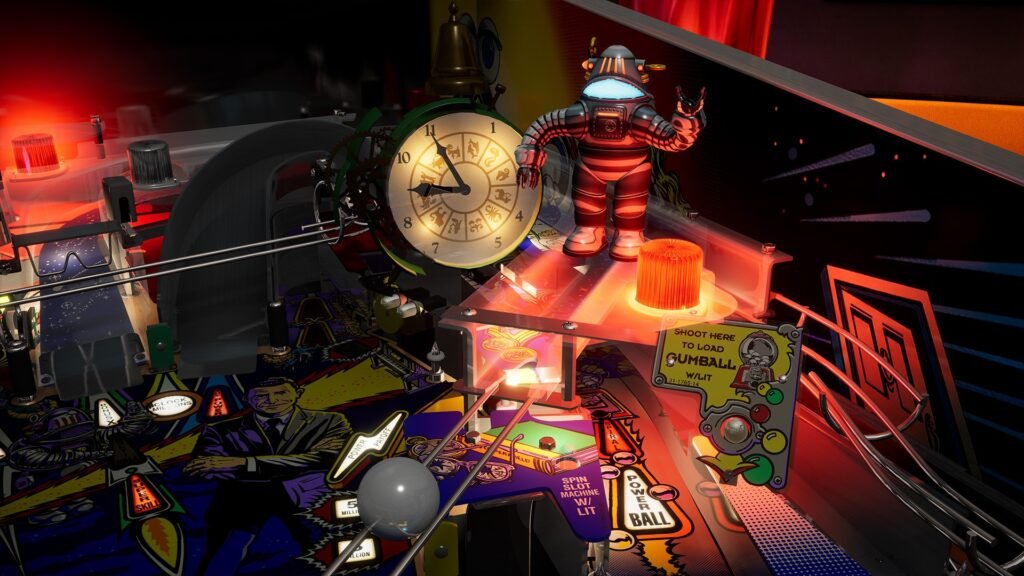
And that surprise is the whole point. Twilight Zone does not play like a neat, orderly checklist game, even though it absolutely has rule depth. It plays like a machine where the rules, toys, and layout are all trying to create that uncanny “something is off here” feeling. That is a rare thing in licensed pinball. Usually you get theme callouts and artwork. Here, you get theme translated into physical behavior.
The Ambition Came With Real Tradeoffs
This is where the history of Twilight Zone pinball gets especially interesting.
The game is legendary now, but it was not some perfectly settled design from day one. It evolved during development, and several features changed between prototype and production. Ted Estes later described cost cutting after the prototypes were built, because Twilight Zone was expensive. That should not surprise anyone who has looked under one.
One of the most famous changes involved the third magnet in the spiral loop. Early versions included it, but production games removed it to cut cost because the rules made limited use of it. Other details changed too. The mini-playfield got clearer instructions because players were confused by the magnetic “flippers.” The pop bumper area went through adjustments because of drain behavior. Even the clock face became part of collector lore, since thousands of production machines used the white clock decal that many people mistakenly assume marks a prototype.
That is one of my favorite things about this machine historically. Twilight Zone was not just ambitious in the abstract. It was ambitious in the messy, expensive, practical way that real game development tends to be. Parts got reevaluated. Features got clarified. Costs got trimmed. And even after all that, the final game still came out feeling excessive.
In a good way.
There is also a strong argument that Twilight Zone landed right at the sweet spot of early-90s Bally/Williams confidence. Pinball was still big enough for a company to greenlight a project like this. The design team could still chase novelty without every decision being squeezed flat by modern production realities. That does not automatically make older games better, but it does help explain why Twilight Zone feels like something from a very specific era of pinball excess.
How The Rules Helped Build Its Reputation
A machine can have all the toys in the world and still get old fast if the rules do not hold up. Twilight Zone avoided that trap.
The center door is the heart of the game. Around it sit fourteen door panels, which act as a mix of modes, light features, and awards. You build toward them through shots like the Piano and Slot Machine, and the long-term goal is to collect them all and reach Lost in the Zone, the wizard mode.
That central structure gave the game a strong identity. It was not just “shoot lit stuff until multiball.” It had a sense of progression that players could feel, even if they did not know every detail. And for better players, there was plenty to dig into. You had multiball, Powerball Mania, Battle the Power on the mini-playfield, slot machine awards, camera strategy, door panel stacking, and the constant tension between short-term points and longer-term progress.
This is another reason Twilight Zone aged well. The game gives casual players a lot to react to, but it also gives stronger players reasons to come back. You can learn feeds. You can learn how to recover from the slot machine kickout. You can learn how to use the upper flippers well. You can get smarter about when to push modes and when to stay controlled.
It is a dense game, but not dense in a dead way. There is enough going on that you keep discovering better ways to play it.
Why Collectors Still Care So Much
Here is the funny part. Twilight Zone was not a tiny-run unicorn. More than 15,000 units were produced, which is a huge number compared to many machines people treat as holy relics. So its reputation is not built on scarcity alone.
It is built on impact.
Collectors still chase it because it has presence, depth, and personality. It is also one of the most modded pinball machines around. Owners add camera mods, mini TVs, gumball enhancements, color displays, lighting changes, and all kinds of visual flourishes because the machine invites that sort of obsession. It already feels theatrical, so people lean into it.
At the same time, Twilight Zone is not a “buy it and forget it” game. It is mechanically packed. The clock, gumball machine, magnets, mini-playfield, and all the moving parts mean maintenance matters. A dialed-in Twilight Zone is one thing. A tired one is another. That maintenance reality is part of the machine’s story too. When people call it one of the greats, they usually mean a good example, not a neglected one limping through half its features.
That is worth remembering if you are thinking about ownership. The legend is real. But the legend comes with wires, mechanisms, adjustments, and time.
What Twilight Zone’s Legacy Really Is
For my money, Twilight Zone matters because it proved a pinball machine could be maximalist and still feel coherent.
Yes, it has a lot of stuff. Everyone knows that part. But the better point is that the stuff mostly belongs there. The clock is not random. The gumball machine is not random. The Powerball is not random. The weird magnet mini-playfield is definitely not random. They all help the game feel like you are dealing with a machine where normal rules have been bent just a little.
That is exactly what the source material did.
And even now, decades later, Twilight Zone still sits comfortably in the upper tier of community rankings. That does not make it objectively perfect. No machine is. Some players think it is too busy. Some prefer faster, simpler games. Some would rather own something easier to maintain. Fair enough. But the fact that a 1993 widebody still holds that level of respect in 2026 tells you a lot.
It tells you the machine was not just big. It was good.
If you ever get the chance to play a well-sorted Twilight Zone, do it. Even if you end up deciding it is not your personal favorite, you will understand why it became one of the hobby’s landmark games. And that, really, is the heart of the story. Twilight Zone did not become famous because it was overloaded. It became famous because its overload had imagination.
FAQs
When Was Twilight Zone Pinball Released?
Twilight Zone was manufactured in 1993, with IPDB listing its manufacture date as April 5, 1993. In practical terms, it is a spring 1993 Bally release.
Who Designed Twilight Zone Pinball?
The concept and design are most closely associated with Pat Lawlor, with Larry DeMar and Ted Estes on design and software, John Youssi on art, and John Krutsch on mechanics.
What Makes The Powerball So Special?
The Powerball is a white ceramic pinball that is lighter than a normal steel ball and not affected by the game’s magnets. That changes both speed and behavior, which makes it feel genuinely different rather than just cosmetic.
Why Is Twilight Zone Called A Widebody Classic?
It is a widebody machine because the cabinet and playfield are broader than standard games, which gave the design team room for more features. In Twilight Zone, that extra space helped make possible the clock, gumball machine, Powerfield, extra flippers, and dense shot layout that define the game.
Is Twilight Zone Hard To Own?
It can be. A good Twilight Zone is fantastic, but it also has more moving parts and mechanical complexity than a simpler game. Ownership is much easier when the machine is already sorted and maintained well.