
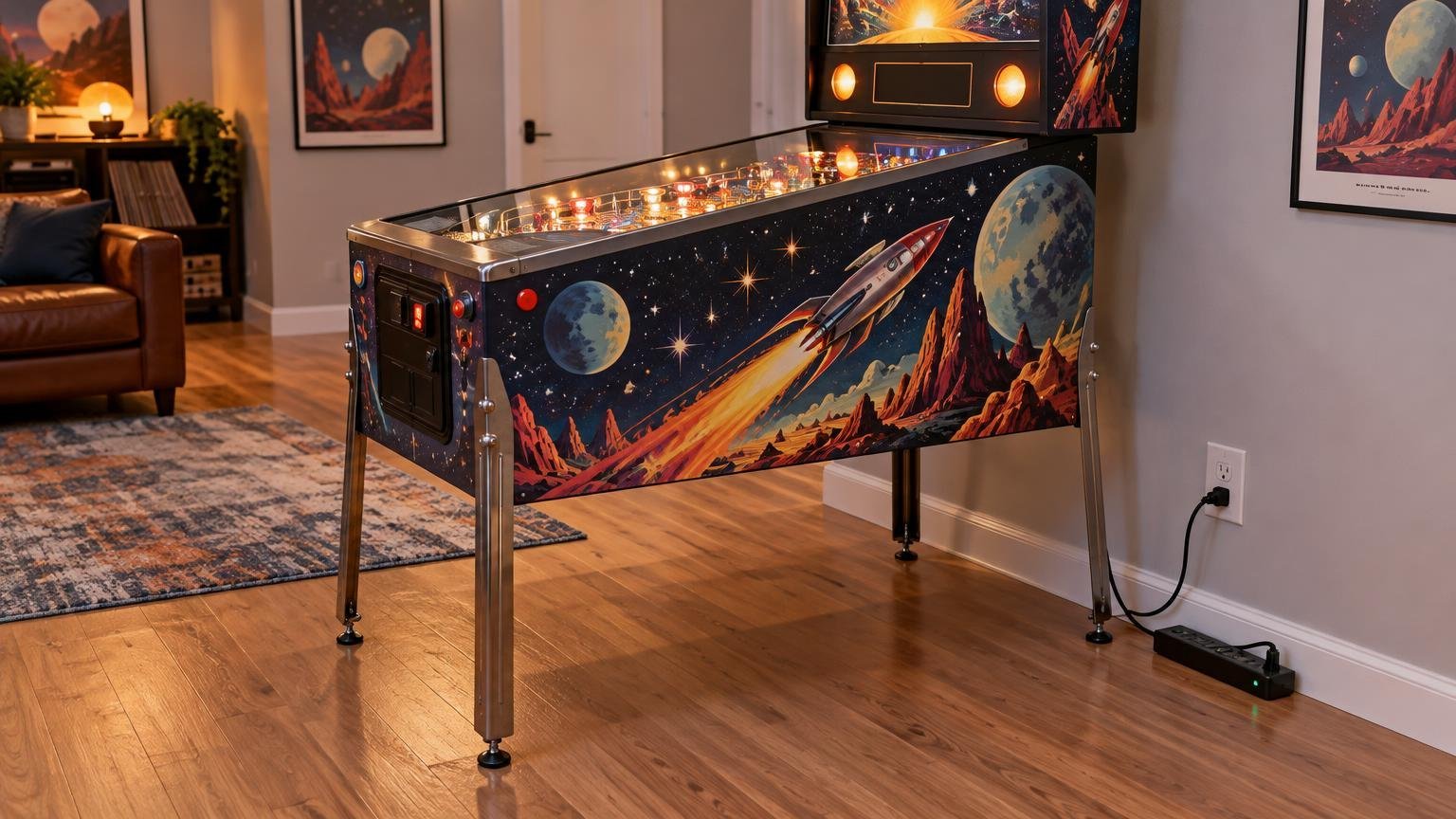
A properly selected pinball machine surge protector is a sensible protective layer for many home installations. It is not, however, a substitute for the machine’s manual, a sound grounded outlet, an undamaged power cord, or a circuit that can safely support everything connected to it.
The practical answer is to start with the exact machine rather than buying an accessory based on a generic pinball recommendation. Check the rear electrical label and model-specific documentation, then choose a surge protector compatible with those documented requirements. Do not expect it to correct bad wiring, prevent every electrical event, or diagnose a machine that resets during play.
Start with the machine label and manual
Pinball machines span different eras, manufacturers, regional configurations, and electrical designs. That makes universal claims about voltage, plug type, current draw, fuse details, or power accessories unreliable. The rear electrical label and the correct manual should guide the setup.
For example, Stern provides model-specific setup information and a library of digital game manuals covering setup, service, parts, and schematics. Owners of Stern games should identify the exact title and edition before relying on those resources. Other manufacturers and older machines may have their own documentation requirements.
This check matters especially when a machine has been imported, converted, restored, or modified. A plug that physically fits an outlet does not by itself establish that the configuration is correct. If the label is missing, illegible, or inconsistent with the plug and wiring, stop and have the machine assessed rather than experimenting with adapters or power accessories.
Power strip versus surge protector
A basic power strip and a surge protector are not interchangeable terms. A power strip primarily provides additional receptacles. A surge protector includes components intended to limit certain voltage surges. UL Solutions explains this distinction in its guide to power strips and surge protectors.
| Device | Primary role | What it does not establish |
|---|---|---|
| Basic power strip | Adds multiple outlets from one receptacle | That the circuit can carry more total load or that connected equipment has surge protection |
| Surge protector | Adds surge-limiting protection when compatible with the connected equipment and supply | Protection from every electrical event, internal machine fault, overload, or wiring problem |
| Extension cord | Temporarily extends reach when appropriate for the application | A safe permanent replacement for correctly located household wiring |
| UPS or battery backup | May provide temporary backup power in compatible applications | Compatibility with an unspecified pinball machine or permission to ignore manufacturer instructions |
The distinction is important because adding receptacles does not add circuit capacity. Several machines, room heaters, refrigerators, dehumidifiers, entertainment systems, or other loads may still share wiring behind the wall. A strip also should not be treated as permission to daisy-chain devices or hide an overloaded arrangement behind a row of cabinets.
How to plan a pinball machine surge protector setup
Choose the machine location before finalizing the power arrangement. The outlet should be grounded and positioned so the machine cord can reach it without being stretched across a walkway, pinched under a leg, or routed beneath a rug. The plug, outlet, and rear of the cabinet should remain accessible enough to disconnect power and perform service.
This is one reason electrical planning belongs in the larger room plan. Before delivery, think through the transport path, playing position, service clearance, lighting, sound, and where the machine might move later. The broader home pinball setup guide covers those room-choice tradeoffs, while the pinball space-planning guide focuses on clearance and moving access.
Once the location is chosen, use a short checklist:
- Read the machine’s electrical label and correct manual.
- Inspect the machine cord and plug for cuts, crushing, looseness, discoloration, or other visible damage.
- Use a properly grounded household outlet suitable for the machine’s documented configuration.
- Select a surge protector compatible with the machine and household supply rather than relying on packaging language alone.
- Keep the cord and protective device visible and away from foot traffic, rugs, moisture, and pinch points.
- Retain access to the wall outlet, power device, cabinet switch, and rear service area.
- Consider what else operates on the same circuit, particularly equipment with substantial or intermittent loads.
- Do not daisy-chain strips, surge protectors, or extension cords.
The U.S. Consumer Product Safety Commission warns against overloaded power strips, damaged cords, improper grounding, and using extension cords as permanent wiring. Its power and extension-cord safety guidance also recommends proper three-wire grounding for appliances with three-prong plugs.
Does a pinball machine need a dedicated circuit?
Not every pinball installation automatically requires a dedicated circuit. The answer depends on the documented requirements of the machine, the other loads on that circuit, and the condition and design of the home’s wiring.
A single machine on a sound circuit may present a different planning problem from a line of machines sharing power with other equipment. The useful question is not simply how many outlets are visible. It is what those outlets share and whether the overall installation is appropriate for the connected loads.
Repeated breaker trips are not an invitation to install a larger breaker, try a different strip, or keep resetting the circuit. Stop using the affected setup and have the cause evaluated. An electrician is the appropriate professional for concerns about the outlet, grounding, breaker, branch circuit, or household wiring. A pinball technician is better suited to faults inside the machine. Some cases may require both.
Can you use an extension cord?
An extension cord should not become the permanent power plan for a pinball machine. If the intended location cannot reach a suitable outlet without a cord crossing the room or disappearing under a rug, reconsider the location or consult an electrician about a properly placed receptacle. The CPSC specifically cautions against treating extension cords as permanent wiring.
Do not use a damaged cord, and do not defeat a grounding pin to make a plug fit. If the machine has a three-prong plug but the room does not provide a suitable grounded receptacle, that is a household electrical issue to correct—not a reason to use an improvised adapter.
What if the machine resets during multiball or flipper use?
A reset that happens when several coils, flippers, or other mechanisms operate may look like a simple wall-power problem, but the symptom does not identify one cause. The power path includes the outlet and external accessories as well as the machine’s power supply, connectors, coils, wiring, and boards. Rock Custom Pinball’s reset guide notes that faults in several of these areas can produce resets during play.
Begin with observation rather than parts swapping. Note whether the entire machine loses power, the display and game software restart, the lights flicker, a breaker trips, or the symptom appears only during a particular mechanism or mode. Record the machine title, edition, software version if readily available, and the exact event preceding the reset.
With the machine switched off and disconnected, an owner can visually inspect the external cord, plug, surge protector, and accessible connections for obvious damage, looseness, discoloration, or heat effects. That is not the same as proving that a board, coil, connector, outlet, or surge protector has failed. Recurring resets warrant model-aware diagnosis rather than repeated play until the fault becomes more severe.
Replacing a visibly damaged external accessory may remove one hazard, but it does not establish that the accessory caused the original symptom. If resets continue with a documented, appropriate power setup, the investigation has moved beyond what a surge protector purchase can solve.
Should you use a UPS or battery backup?
Do not assume that a UPS is automatically better than a surge protector for a pinball machine. Compatibility depends on the exact machine and the UPS, and the available evidence does not support a universal battery-backup recommendation.
Use a UPS only when the machine manufacturer’s documentation or qualified technical guidance supports it and the device is appropriate for the machine’s documented electrical requirements. A backup device adds another component to maintain, position, inspect, and troubleshoot. If the actual goal is simply surge protection, adding battery backup may introduce complexity without solving a defined problem.
Warning signs that mean stop playing
Disconnect the machine and investigate promptly if you notice smoke, a burning smell, damaged insulation, a scorched plug, or abnormal heat at a plug or connector. Rock Custom Pinball also advises stopping use when smoke, burning odor, or a hot connector is present.
Repeated resets and breaker trips also deserve attention even when there is no smoke or odor. Continuing to play may make an intermittent problem harder to interpret and could worsen damaged connections. Do not open covers, reach into energized assemblies, replace fuses with different ratings, or perform live measurements unless the official service procedure calls for it and you have the appropriate training.
For a repair inquiry, document the game title, a precise description of the symptom, when it occurs, and any useful photos or video. Rock Custom Pinball accepts Utah repair inquiries through its contact page, but service scope, availability, territory, pricing, and turnaround should be confirmed directly.
The practical answer
Use a pinball machine surge protector as one layer in a complete power plan, not as a cure-all. Start with the exact machine’s label and manual, provide a grounded and non-overloaded connection, keep cords visible and protected, and preserve access for disconnection and service.
If the room requires permanent extension-cord use, the breaker repeatedly trips, or the machine resets under load, solve that underlying problem instead of upgrading accessories by guesswork. The best next step may be a different location, an electrician’s assessment, a pinball technician’s diagnosis, or both.