
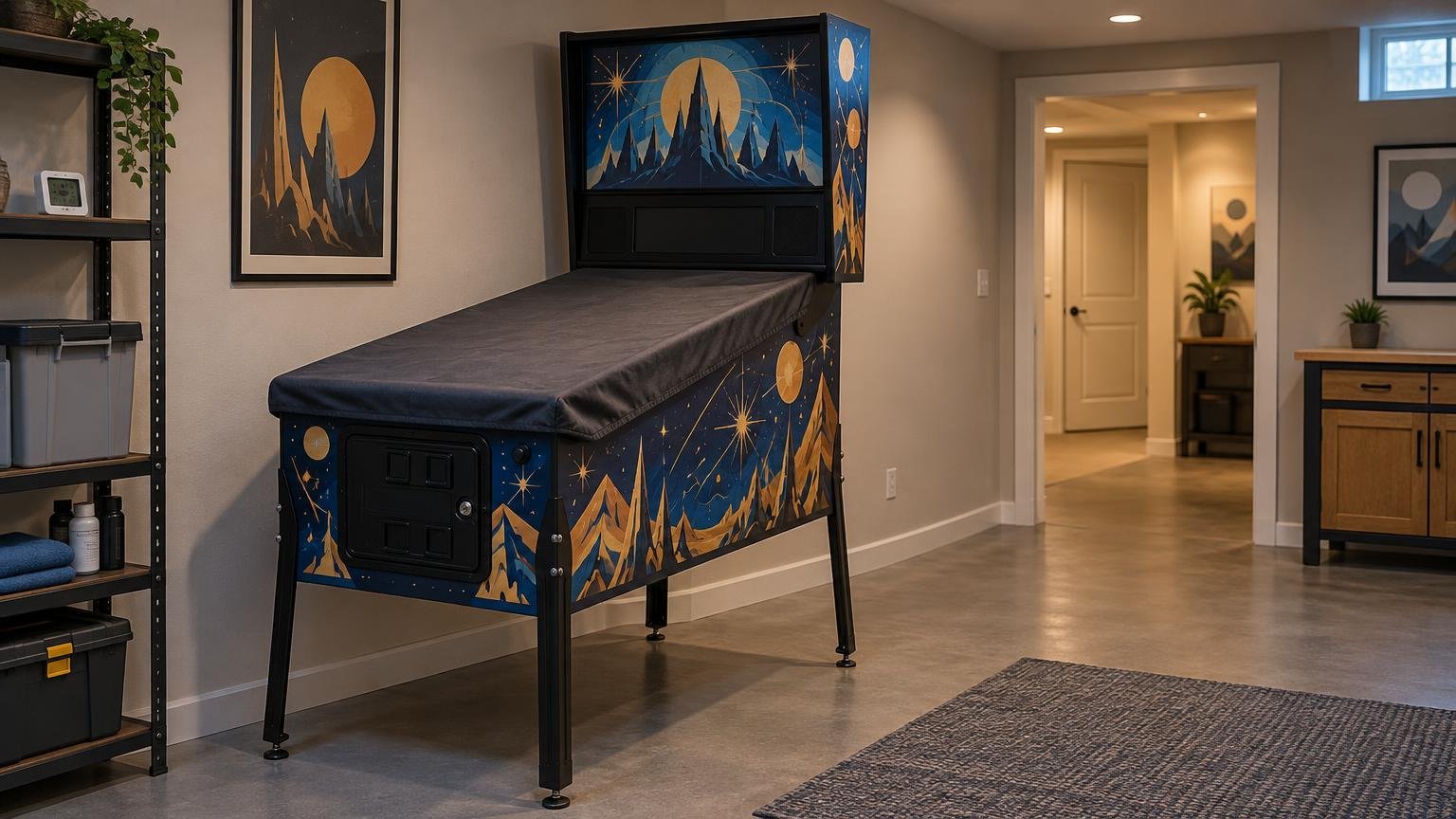
A pinball machine can remain in a home for years without becoming a constant problem, but only if its location works for the machine and the household. Before delivery, confirm that the route is passable, the room is dry and stable, the outlet is suitable, and there is enough clearance to play and service the game. If the machine will sit unused, environmental stability and model-specific preparation matter more than simply covering it.
The safest way to store pinball machine long term is to treat storage as an ownership plan rather than a parking spot. Decide whether the game will remain assembled and occasionally played, become inactive for months, or be prepared for a future move. Each scenario creates different requirements for access, cleaning, power, inspection, and handling.
First decide what “long-term storage” means
An assembled machine in a finished game room is not stored in the same sense as a machine placed in a garage or storage unit. Start by identifying the actual scenario.
| Scenario | Main priority | Common planning mistake |
|---|---|---|
| Active home placement | Comfortable play, power, noise control, and service clearance | Measuring only the cabinet instead of the route and working area |
| Seasonal or inactive storage | Stable, dry, non-condensing conditions with periodic observation | Assuming a cover can compensate for a poor environment |
| Storage before a move | Machine-specific preparation, secure handling, and a clear exit route | Disassembling or folding parts without the correct manual |
| Uncertain future use | Preserving condition, documentation, original parts, and removability | Installing permanent changes before the machine’s future is clear |
If the machine will remain playable, plan it as furniture that also needs mechanical service. If it will be inactive, prioritize the environment and your ability to inspect it. If it will be moved again, preserve a workable route out of the home rather than choosing a location that is easy to enter but difficult to leave.
Measure the entire route, not just the room
Measure exterior doors, interior doors, hallways, tight turns, stair widths, landings, ceiling restrictions, and the final approach to the room. Door hardware, handrails, low light fixtures, and sharp turns can matter as much as the nominal width of an opening. A basement may have plenty of floor space while still being a poor destination because of its stairs or landing geometry.
Machine dimensions and weights vary by title, edition, and era. As one modern example, the official Teenage Mutant Ninja Turtles Pro manual lists an assembled size of 76–78 inches high, 27.75 inches wide, and 57 inches deep, with a weight of 210 pounds. That manual also specifies two people for moving and maneuvering the machine. Those figures are useful for understanding the scale of the planning problem, but they are not universal specifications. Check the manual for the exact title and edition you own or intend to buy. The official Stern operation and parts manual provides the model-specific example.
Do not assume every backbox folds the same way, every set of legs attaches identically, or every machine has the same loose components. Vintage electromechanical games, later solid-state machines, and current models can require different preparation. Use the correct documentation or qualified help rather than adapting instructions written for another title.
Plan an active footprint around the machine
Cabinet dimensions describe only the machine. A practical home location also needs standing room for the player, a safe traffic path, clearance for nearby doors and furniture, and access to the coin door and playfield. A machine pushed tightly into an alcove may fit physically but become difficult to clean, diagnose, or open for service.
Think through how glass could be removed, how the playfield would be raised according to the manufacturer’s instructions, and whether a technician could work without moving the machine through the house. Avoid locations where routine access would block an exit or require balancing tools and parts on stairs. The broader home pinball setup guide covers room choice and delivery planning in more detail.
Floor condition matters too. The machine should be stable and capable of being leveled, but the suitability of a particular floor cannot be determined from a generic rule. Uneven surfaces, damaged flooring, unusual structures, or uncertainty about load capacity deserve a site-specific assessment.
Account for noise, vibration, and other people
Pinball noise is not limited to speaker volume. Flipper coils, ball impacts, pop bumpers, kickers, mechanical toys, cabinet vibration, and optional shaker motors can transmit sound through walls and floors. A machine beside a bedroom or directly over a quiet room may be acceptable in the afternoon and disruptive late at night.
Before committing to a location, consider who shares adjacent rooms and when the machine will be played. Rugs, room layout, volume settings, and operating hours may help, but they do not eliminate mechanical impacts. Do not rely on a universal decibel estimate; titles, settings, room construction, and installed hardware differ too much for one figure to settle the question.
Check power using the exact machine documentation
Place the machine where its cord can reach an appropriate outlet without being stretched across a walkway, pinched behind furniture, or turned into a trip hazard. Check the title-and-edition manual for voltage, frequency, and consumption information, and avoid casually adding the game to a circuit already supporting substantial loads.
For example, the Teenage Mutant Ninja Turtles Pro manual specifies 120 VAC at 60 Hz for its North American configuration, with 360 watts of nominal consumption and a brief 540-watt peak lasting less than 100 milliseconds. Those are model-specific planning figures, not a generic rating for modern or vintage pinball machines. If the outlet, circuit, grounding, cord, plug, or machine power hardware raises concerns, stop and involve an appropriately qualified technician.
How to store a pinball machine long term in an inactive space
The storage environment should be dry, reasonably stable, and free from condensation. Investigate the space rather than judging it by how it feels during one visit. Look for past leaks, plumbing risks, floor drains, exterior water entry, direct sunlight, pests, wet concrete, and large seasonal temperature changes.
The same Stern manual lists a storage range of 32–104°F and 5–95% relative humidity, non-condensing, for that specific machine. This illustrates why condensation is a distinct concern: a reading can fall inside a broad numerical range while rapid environmental changes still create moisture. Use the limits in your own machine’s documentation rather than treating this example as permission to use any garage, shed, or storage unit.
Basements
A finished, dry basement can offer stable temperatures, but inspect for sump, plumbing, seepage, and flood risks. Keep the removal route in mind. A machine that can be brought down only through a difficult turn may become expensive or risky to remove later.
Garages and storage units
These spaces require more scrutiny because temperature swings, condensation, dust, pests, vehicle moisture, and water entry can be harder to control. Climate control can be a sensible preference when the alternative environment is unstable, but the machine manual and actual site conditions should determine the requirement. A fitted cover may reduce dust; it does not correct dampness, condensation, flooding, or extreme swings.
Before leaving the machine inactive
Clean the machine according to its documentation, photograph its overall condition, record any existing faults, and keep keys, manuals, removed parts, and service notes organized. The home pinball cleaning schedule can help separate routine cleaning from deeper work. Do not apply an unfamiliar chemical or lubricant merely because the game will be stored.
Follow the exact manual for shutdown, loose-component preparation, battery-related precautions, backbox handling, leg removal, and transport. These procedures are not safely interchangeable across machines. If documentation is missing or the machine has undocumented alterations, have a knowledgeable technician inspect it before disassembly or extended storage.
Keep maintenance and future service in the plan
When returning a machine to use, inspect it before applying power. An owner can safely look for obvious moisture, pest activity, damaged cords, loose exterior hardware, strange odors, or visible cabinet damage. Those observations can suggest that deeper inspection is needed, but they are not a complete electrical or mechanical diagnosis. If a problem appears after storage, use a structured pre-service pinball troubleshooting checklist and stop before energized testing that exceeds your skills or documentation.
Treat modifications as a serviceability decision
A storage or room plan can be undermined by poorly routed mod wiring, blocked playfield access, extra heat, or accessories that interfere with moving parts. Prefer machine-specific, documented, non-destructive installations. Protect wiring from hot, sharp, and moving components, retain original parts, and make sure future service remains possible. Rock Custom Pinball’s mod guidance emphasizes those practices as company guidance rather than independent engineering certification. The detailed reversible pinball mod wiring guide explains the service-access tradeoffs.
Warranty status should also be checked before modifying a newer machine. Stern states that unauthorized modifications, improper installation or repair, non-genuine parts or accessories, and use inconsistent with instructions can affect warranty coverage. That does not mean every aftermarket accessory automatically cancels all coverage, but it does make documentation and manufacturer guidance important. Review the manufacturer’s current warranty terms before proceeding.
Pre-delivery and long-term storage checklist
- Identify whether the machine will be actively played, seasonally inactive, or prepared for another move.
- Measure every doorway, hallway, turn, stair, landing, and ceiling restriction on the route.
- Verify the exact machine’s dimensions, weight, moving method, power requirements, and environmental limits.
- Leave room for the player, household traffic, coin-door access, cleaning, and playfield service.
- Consider mechanical noise and vibration, not only speaker volume.
- Inspect the destination for leaks, condensation, pests, direct sun, unstable temperatures, and water exposure.
- Keep the power cord protected and use an appropriate outlet and circuit.
- Document the machine’s condition, faults, keys, manuals, modifications, and original parts.
- Use model-specific instructions before folding, disassembling, moving, or preparing the machine for storage.
- Arrange qualified help when the route, electrical condition, structure, or machine preparation exceeds your knowledge.
Choose the room before the machine arrives
The best long-term location is not merely the empty corner where a pinball cabinet fits. It is a dry, accessible place with a manageable delivery route, suitable power, acceptable noise impact, and enough working clearance to maintain the game. For inactive storage, stable non-condensing conditions and machine-specific preparation should take priority over convenience.
Measure first, locate the exact manual, document the machine, and resolve environmental or access concerns before delivery day. Utah owners who need help separating an observable symptom from a service job can review available Utah pinball machine repair support without assuming that every machine, location, or project has the same requirements.