TLDR
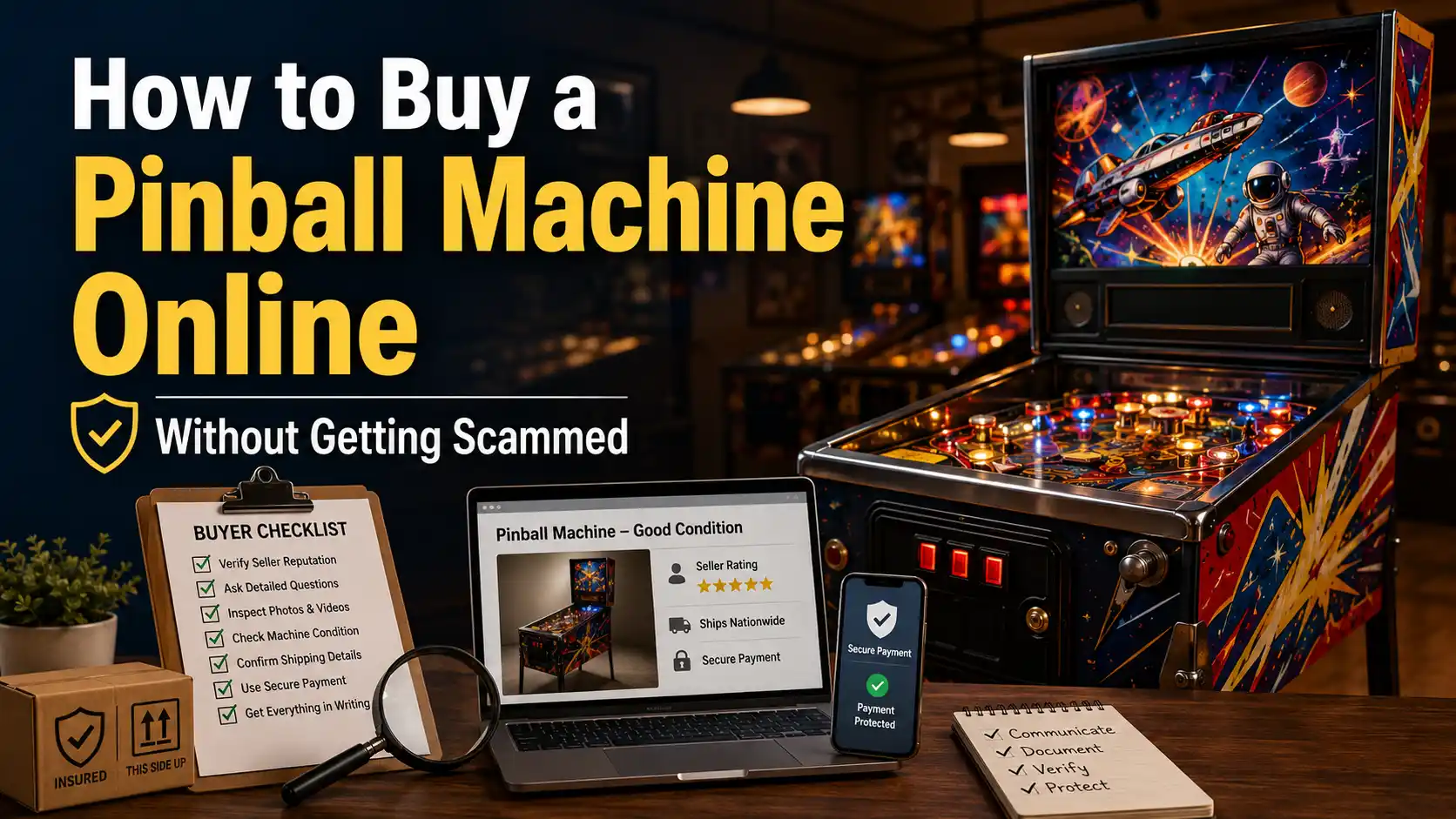
Buying a pinball machine online can be safe, but the hobby has enough scam websites, fake seller profiles, risky preorder transfers, and payment traps that buyers need a process.
The safest path is simple:
- Buy from a verified dealer when purchasing new-in-box.
- Confirm dealer status directly through the manufacturer.
- Avoid irreversible payments unless the seller is deeply trusted and the machine is physically controlled by that seller.
- Use a credit card or protected payment method when possible.
- Get current photos, video, serial information, and written terms.
- Be careful with preorder allocations, “too good to be true” prices, and sellers who rush you.
- Do not wait past your dispute window if the machine does not ship.
A real pinball machine is expensive, heavy, and hard to unwind once the wrong money goes to the wrong place. The goal is not to be paranoid. The goal is to buy like someone who understands the risk before the truck shows up.
Buying Pinball Online Is Different From Buying Most Things Online
A pinball machine is not a normal online purchase.
It is not a shirt, a game controller, or a replacement part. A modern pinball machine can cost several thousand dollars. A Limited Edition can cost much more. A vintage or collectible machine may involve restoration claims, freight shipping, missing parts, board work, cabinet damage, or private-party history that only the seller knows.
That creates a strange buying environment.
The pinball community is often friendly and helpful, but the money involved is serious. A scammer only needs one buyer to send a wire, a Friends and Family payment, or a deposit on a fake machine to make the whole scheme worth it.
That is why online pinball buying needs a checklist.
Not because every seller is suspicious. Most are not. But the honest sellers will understand why you are careful. The bad sellers will try to make you feel rushed, annoying, or unreasonable for asking normal questions.
That difference tells you a lot.
The Big Question: Are You Buying From a Dealer or a Private Seller?
The first thing to clarify is what kind of transaction you are actually entering.
There are three common types of pinball purchases:
- Buying a new-in-box machine from a dealer
- Buying a used machine from a private seller
- Buying a preorder, allocation, or machine that has not arrived yet
Each one has a different risk profile.
A new-in-box dealer purchase is usually the cleanest if the dealer is legitimate and currently authorized for that manufacturer. A private sale can be perfectly fine, but the buyer has to verify the machine and seller more carefully. A preorder transfer is the riskiest because you are often buying a promise instead of a physical machine.
The mistake many buyers make is treating all three like the same thing.
They are not the same thing.
A seller who physically owns a machine can show it to you. A dealer with a confirmed allocation can invoice you directly. A person selling a preorder spot may not control the machine, the refund path, or the delivery schedule.
That matters.
Step 1: Verify the Dealer Before You Send Money
If you are buying a new Stern, Jersey Jack, Chicago Gaming, American Pinball, Barrels of Fun, Spooky, Pinball Brothers, Multimorphic, or any other new machine, do not rely only on the seller’s website.
A website can say almost anything.
A dealer badge can be outdated. A logo can be copied. An “authorized dealer” claim can remain on a page after the relationship changes. A fake site can clone a real dealer’s branding.
Before sending a deposit or balance, verify the dealer through the manufacturer’s current dealer or distributor list. If the manufacturer has a dealer finder, use it. If the situation feels unclear, contact the manufacturer directly.
Ask a simple question:
“Is this business currently authorized to sell this machine, and can they take payment for it?”
That may feel like overkill. It is not. If you are about to send thousands of dollars, it is a normal verification step.
A legitimate dealer should not be offended by it.
Step 2: Check the Seller’s Reputation in the Pinball Community
Pinball has a useful advantage: the community remembers things.
Pinside, regional Facebook groups, local leagues, repair techs, arcade operators, and collectors often know which sellers are reliable and which ones have a history of messy deals.
Before buying, search the seller’s name, business name, phone number, email address, and website domain. Look for:
- Pinside feedback
- Pinside forum mentions
- Marketplace history
- Facebook group history
- Google Business Profile reviews
- BBB profile, if applicable
- State business registration
- Local pinball community references
- Prior sale posts using the same photos
- Complaints about refunds, shipping, or communication
One negative comment does not always mean a seller is bad. Pinball people argue. Machines break. Buyers misunderstand condition. Sellers get busy.
But patterns matter.
If multiple buyers describe missing machines, refund delays, shifting explanations, or pressure to use unprotected payments, stop.
Step 3: Be Extra Careful With Prices That Are Too Low
Scam listings often work because they show you the machine you already want at a price you want to believe.
A modern premium listed thousands below market should make you pause. A Limited Edition priced like a Pro should make you pause. A rare title available from a website you have never heard of should make you pause.
A good deal can exist. A desperate seller can exist. A collector who wants a fast local sale can exist.
But a suspiciously cheap pinball machine is usually cheap for a reason.
Before assuming you found a steal, compare the price against recent marketplace listings, Pinside values, dealer pricing, and local sales. Also remember that condition matters. A game with a blown board, broken display, missing topper, cabinet fade, or years of route wear may look cheap because the repair bill is hiding in the photos.
The safer mindset is this:
A good deal should survive verification.
If the seller disappears, pressures you, or refuses basic proof after you ask normal questions, it was not a good deal.
Step 4: Ask for Proof That the Machine Exists
If the seller claims to have the machine, ask for current proof.
Not old photos. Not manufacturer images. Not screenshots from another listing. Not “I can send that later.”
Ask for:
- A current photo of the full machine
- A current photo of the playfield
- A current photo of the cabinet sides
- A current photo of the backbox
- A current photo of the serial number or identifying plate if available
- A short video of the machine powered on
- A short video showing the display, flippers, lights, and gameplay
- A photo with today’s date and the seller’s name written on paper next to the machine
A legitimate private seller should be able to do this easily.
A scammer will usually stall, send blurry images, reuse polished listing photos, claim the machine is already wrapped, or say they are traveling.
That does not automatically prove fraud, but it is a red flag.
If the machine is expensive, a live video call is even better. Ask the seller to walk around the machine, open the coin door, show the playfield, and say your name or the date. That makes stolen photos much less useful.
Step 5: Understand the Payment Risk Before You Pay
Payment method is where many bad pinball deals become unrecoverable.
The safest payment options are usually the ones that preserve a real dispute path. Credit cards often offer stronger protections than wires, Zelle, Venmo, crypto, cashier’s checks, or PayPal Friends and Family.
The key issue is reversibility.
If the seller takes your money and never ships the machine, what can you actually do?
A protected payment method does not guarantee you will win every dispute. But it gives you a process. An irreversible payment may leave you with little more than screenshots and regret.
Be especially cautious if the seller pushes for:
- Wire transfer
- Zelle
- Venmo
- Cash App
- PayPal Friends and Family
- Cryptocurrency
- Gift cards
- Cashier’s check to an unknown seller
- “Pay the shipper directly” arrangements
- Payment split across strange accounts
- Payment to a different name than the seller or business
There are legitimate reasons some private sellers prefer certain payment types. That is true.
But the more risk the seller pushes onto the buyer, the more confidence you need in the seller.
For an expensive remote transaction, “just trust me” is not enough.
Step 6: Do Not Use Friends and Family for a Purchase
This one deserves its own section because it comes up constantly in hobby marketplaces.
PayPal Friends and Family is for friends and family. It is not for buying a pinball machine from a stranger.
If a seller asks you to use Friends and Family because “the fees are annoying,” remember what is really happening: you are giving up purchase protection to save the seller a fee.
That may be fine if you know the seller personally and accept the risk. It is a bad idea with an unknown seller.
The same logic applies to any payment method that removes your ability to dispute the transaction. When the item is a $30 part, some buyers may choose to take that risk. When the item is a $7,000 to $15,000 machine, that is a very different conversation.
Step 7: Be Careful With Preorders and Allocation Transfers
Preorders can be normal in pinball. Allocation transfers are where things get messy.
A preorder is not a machine sitting in someone’s game room. It is a future claim. That future claim may depend on a dealer, distributor, manufacturer schedule, production run, payment status, and original buyer information.
Before buying a preorder spot, ask:
- Who placed the original order?
- Who paid the dealer?
- Is the order fully paid or deposit-only?
- Is the dealer aware of the transfer?
- Will the dealer invoice the new buyer directly?
- If the machine is cancelled, who receives the refund?
- If the original buyer receives the refund, are they obligated to refund the new buyer?
- What happens if the dealer cannot deliver?
- What happens if production changes?
- What payment method was originally used?
- Is there still a chargeback window?
If the answer is “don’t worry about it,” worry about it.
A preorder transfer can go wrong even when no one intended to scam anyone. The seller may think they sold an allocation. The buyer may think they bought a machine. The dealer may only recognize the original payer. The refund may go back to the wrong person. The chargeback right may belong to someone who is no longer the final buyer.
That is a terrible place to be after thousands of dollars have moved.
If you are buying a preorder spot, get the dealer to confirm the transfer directly in writing before you pay.
Step 8: Get the Terms in Writing
A surprising number of expensive pinball deals happen through casual messages.
That is fine until something goes wrong.
Before paying, write down the terms in plain language. It does not need to look like a corporate contract, but it should answer the important questions.
For a used machine, the written terms should include:
- Machine title and trim
- Serial number, if available
- Included accessories
- Included topper, mods, art blades, shaker, side armor, or extras
- Known defects
- Working condition
- Price
- Deposit amount
- Balance due
- Payment method
- Pickup or shipping plan
- Who arranges freight
- Who pays freight
- What happens if freight damage occurs
- Whether the sale is final
- Any promised repairs before shipment
For a new machine or preorder, include:
- Dealer name
- Buyer name on invoice
- Machine trim
- Deposit amount
- Balance due
- Estimated delivery window
- Refund policy
- Cancellation policy
- Whether payment is refundable
- Who receives a refund if the order fails
- Whether the buyer is paying the dealer directly
This protects both sides.
Good sellers should want clear expectations too.
Step 9: Watch for Shipping and Freight Traps
Pinball machines are heavy and awkward. Shipping them is not like shipping a chair.
A legitimate seller should be able to explain how the machine will be prepared for shipment. That usually means removing balls, securing the playfield, folding or removing the head depending on the machine, wrapping the cabinet, strapping to a pallet or using a specialized carrier, and documenting condition before pickup.
Ask:
- Who is arranging shipping?
- Which carrier is being used?
- Is the machine insured?
- Who files a claim if it is damaged?
- Will there be liftgate service?
- Is it curbside delivery or inside delivery?
- Is the machine being shipped legs-off?
- Has the seller shipped pinball machines before?
- Will photos be taken before pickup?
Be cautious if a seller tries to separate the transaction into strange pieces, such as asking you to pay a mysterious shipper through a separate method before the machine is released.
That kind of setup is common in many online scams. A real freight arrangement should have a carrier name, tracking, bill of lading, pickup address, delivery address, insurance details, and clear payment path.
Step 10: Inspect the Machine Like a Buyer, Not a Fan
When you finally see the machine, stay disciplined.
It is easy to get excited. You are standing in front of the game you wanted. The lights are on. The seller seems nice. The theme is calling to you.
Still, inspect it.
Check:
- Cabinet damage
- Water damage or swelling
- Backbox condition
- Playfield wear
- Insert lifting or cupping
- Planking or clearcoat issues
- Display problems
- Flipper strength
- Switch errors
- Coil errors
- Broken plastics
- Missing parts
- Board corrosion
- Battery leakage
- Burnt connectors
- Credit dot or error messages
- Shooter lane wear
- Ramp cracks
- Magnet behavior, if applicable
- Topper and mod function
- Coin door and service buttons
- Legs, bolts, keys, manuals, and accessories
A game can still be worth buying with issues. You just need the price to reflect the reality.
If you are new to pinball, consider paying a local tech to inspect a higher-dollar machine. That cost is small compared with buying a project machine by accident.
Step 11: Do Not Let the Seller Rush You
Urgency is a classic pressure tool.
Common lines include:
- “I have another buyer coming tonight.”
- “This price is only good today.”
- “I need the deposit now.”
- “My shipper is waiting.”
- “I am moving tomorrow.”
- “I can only take wire.”
- “I already packed it, so I cannot send more photos.”
- “You are overthinking this.”
- “Everyone in the hobby pays this way.”
Sometimes urgency is real. Sellers move. Buyers flake. Good machines sell quickly.
But pressure should not replace verification.
If the seller will not give you enough time to confirm the machine, payment path, and shipping details, walk away. There will be another machine.
There is always another machine.
Step 12: If Something Goes Wrong, Act Quickly
If the machine does not ship, the seller stops responding, or the refund keeps getting delayed, do not wait forever.
Start documenting immediately:
- Save emails
- Save texts
- Save invoices
- Save screenshots
- Save payment records
- Save shipping promises
- Save tracking information
- Save refund promises
- Save seller profile information
- Save the original listing
Then contact your payment provider before the dispute window closes.
This is where many buyers make a painful mistake. They want to be patient. They believe the seller is almost ready to ship. They accept another delay. Then another. Then the window to dispute the charge becomes harder or closes completely.
Being polite is good. Losing your payment protection is not.
If the seller is legitimate, a formal dispute may be uncomfortable, but it can be resolved. If the seller is not legitimate, waiting only helps the seller.
When Renting Makes More Sense Than Buying Blind
One of the safest ways to avoid a bad pinball purchase is to spend time with real machines before buying.
That is especially true for home buyers who are not sure what style of game they actually like. A machine can look perfect in videos and still feel wrong in your house. The shots may be too tight. The code may be too shallow. The theme may get old. The sound package may annoy your family. The game may be too punishing for guests.
That is where Utah pinball rentals can make sense.
A rental gives you real time with a machine without taking on the full cost, transportation, repair risk, and resale process of ownership. For families, offices, events, and first-time buyers, renting can answer questions that online reviews never will.
If you already own a machine and something feels off, Utah pinball machine repair can also help you figure out whether the problem is a simple adjustment, a worn part, or a deeper issue that should affect whether you keep, sell, or upgrade the machine.
Buying is great when you know what you want. Renting is useful when you are still learning what you actually enjoy.
The Safer Pinball Buying Checklist
Before sending money, run through this checklist.
Seller Verification
- Search the seller’s name.
- Search the business name.
- Search the email address.
- Search the phone number.
- Search the domain.
- Check Pinside and community history.
- Ask local collectors if they know the seller.
- Confirm that photos are not stolen from another listing.
Dealer Verification
- Use the manufacturer’s dealer finder.
- Contact the manufacturer if unsure.
- Confirm the dealer can sell that machine.
- Make sure your name is on the invoice.
- Confirm refund and cancellation terms.
Machine Verification
- Ask for current photos.
- Ask for a current video.
- Ask for serial or identifying details.
- Ask for condition disclosure.
- Ask for photos with name and date.
- Use a live video call for expensive remote deals.
Payment Protection
- Prefer credit card when possible.
- Avoid Friends and Family for purchases.
- Avoid wires to unknown sellers.
- Avoid crypto and gift cards.
- Avoid payment to unrelated names.
- Know your dispute deadline.
- Keep copies of all payment records.
Shipping Protection
- Confirm the carrier.
- Confirm insurance.
- Confirm pickup and delivery terms.
- Confirm who files a claim if damaged.
- Get photos before shipment.
- Make sure the machine is packed correctly.
Preorder Protection
- Confirm the order with the dealer.
- Confirm the transfer is allowed.
- Confirm who gets refunded if cancelled.
- Confirm whether the original buyer still controls the payment rights.
- Avoid casual allocation transfers without written dealer confirmation.
Our Take
Buying a pinball machine online can be a great experience. Many collectors, dealers, and private sellers are honest people who love the hobby and want smooth transactions.
But pinball is expensive enough that “trust me” is not a process.
The safest buyers are not cynical. They are organized.
They verify the seller. They verify the dealer. They use protected payment methods. They get the condition in writing. They ask for current proof. They understand shipping. They do not let excitement override common sense.
The machine should be the fun part.
The transaction should be boring, clear, and documented.
If it is not, slow down.
FAQ
What is the safest way to buy a pinball machine online?
The safest way is to buy from a verified dealer or a well-known seller, use a protected payment method, get a written invoice, confirm the machine or allocation directly, and avoid irreversible payments unless you fully trust the seller.
Should I wire money for a pinball machine?
A wire can be normal in some established dealer or trusted collector relationships, but it is risky with unknown sellers or machines that are not physically in hand. Once a wire is sent, recovery may be difficult.
Is PayPal Friends and Family safe for buying pinball?
No. Friends and Family is not meant for purchases from strangers. If you are buying a machine, use a payment method that provides purchase protection.
How do I know if a pinball dealer is legitimate?
Check the manufacturer’s current dealer or distributor list. For Stern machines, use Stern’s official dealer finder. If something looks unclear, contact the manufacturer directly before paying.
What should I ask a private seller before buying?
Ask for current photos, a current video, serial information if available, condition details, known issues, included accessories, payment terms, shipping plans, and seller references.
Are preorder transfers safe?
They can be risky. A preorder transfer should only happen with written dealer confirmation, clear refund terms, and a protected payment path. Never assume the refund will automatically go to you if the original buyer placed the order.
What is the biggest red flag in an online pinball sale?
The biggest red flag is pressure to send irreversible money before you can verify the machine, seller, dealer, or shipping plan.