TLDR
Dungeons & Dragons pinball is not too much for casual players in a home setting, but it can be too much for quick one-and-done play.
The core issue is not that the game is impossible to play. The issue is that Dungeons & Dragons: The Tyrant’s Eye wants to be a campaign game. It has character classes, leveling, items, a map, saved progress, dungeons, multiballs and long-term unlocks. That is great for owners and families who want something to return to. It is less ideal for guests who just want to understand the whole game in five minutes.
My read: D&D is a strong home pinball machine, a very good “learn over time” game and a mixed choice for events or casual public play.
The Big Question: Is D&D Pinball Too Much?
Here is the funny thing about Dungeons & Dragons pinball: the same feature that makes it special is also the thing that makes people nervous.
This Dungeons & Dragons pinball review really comes down to one question. Do you want a pinball machine that plays like a quick arcade toy, or do you want a pinball machine that behaves more like a fantasy campaign?
Stern’s Dungeons & Dragons: The Tyrant’s Eye is clearly built for the second group. It wants you to pick a character, make progress, collect gear, learn the map and slowly understand what the machine is asking from you. That can sound like homework if you are thinking about a party game. But in a home arcade, it can be exactly the hook that keeps people coming back.
I do not think D&D is too much for casual players by default. I do think it asks a little more patience than something like Medieval Madness, Deadpool or Godzilla. A casual player can walk up, shoot the dragon, enjoy the lights and have a good time. But a casual player will not understand why their choices matter unless someone explains the game or they play enough to start seeing the structure.
That makes this one of the more interesting modern Stern reviews. It is not just “good or bad.” It is a question of setting.
What Dungeons & Dragons: The Tyrant’s Eye Is Trying To Be
D&D pinball is not just a licensed theme slapped onto a standard layout. It is Stern trying to make a fantasy RPG work under glass.
You choose a starting character such as Paladin, Wizard, Cleric or Rogue, then work through a map-based campaign. The machine also includes unlockable characters, including Ranger, Barbarian and Bard. The official feature matrix lists over 45 monsters, three campaign endings, 100 collectible trinkets, local cooperative play and PinSave support through Insider Connected.
That is a lot.
But it also explains why the game has generated so much conversation. D&D pinball is not trying to be the cleanest tournament shooter. It is trying to create that “one more quest” feeling. A good home game does not only need to impress you on game one. It needs to stay interesting on game 200.
On that front, D&D has a real argument.
The game gives you a campaign map, dungeon crawls, stores, trinkets, character progress and different endings. Stern’s PinSave system lets connected players save character experience, inventory and campaign progress. That one feature changes the way you think about the machine. Instead of every game being a reset, D&D can feel like you are continuing your adventure.
That is great for an owner. It is less clean for a guest.
Casual Player Fit Depends On The Type Of Casual Player
“Casual player” can mean several different things.
A casual player might be your kid, spouse or friend who plays a few games every night but does not read rule sheets. It might mean a guest at a party who has never touched a modern pinball machine. It might mean someone who loves fantasy and board games but is not a serious pinball player.
Those are not the same person.
| Player Type | Fit | Why |
|---|---|---|
| Home family player | Good | The campaign gives people a reason to keep playing over time. |
| First-time party guest | Mixed | The theme is fun, but the rules will not be obvious. |
| D&D fan who likes pinball | Strong | The RPG structure is the whole point. |
| Pinball purist | Mixed | The story depth is great, but some players may want a cleaner shooter. |
| Office or event crowd | Mixed | It has spectacle, but it may need more explanation than simpler games. |
| Long-term collector | Strong | The depth, code and progression are built for repeat play. |
This is why people can disagree about D&D and both be right.
On location, where someone might play once or twice, D&D can feel busy. At home, where the same people return to the machine, the same depth becomes the payoff.
The Rules Depth Is The Feature, Not A Side Effect
Dungeons & Dragons pinball has rules depth in the most literal sense. You are not just lighting modes. You are choosing locations, fighting monsters, using items, collecting trinkets and moving through a campaign.
That sounds like a lot because it is a lot.
But the game does not require you to understand every layer right away. A new player can still do basic pinball things: shoot flashing shots, hit the dragon, start multiball and try to keep the ball alive. The problem is that the machine is always hinting that there is more going on. For some people, that is exciting. For others, it feels like they are missing the point.
The best way to think about it is this:
D&D is not hard to start. It is hard to fully read.
That is an important distinction. A game can be beginner-playable without being beginner-transparent. D&D lands in that middle zone. You can flip and enjoy it, but the machine gets much better when you start to understand what the locations, colors, items and character choices are doing.
PinSave helps a lot here. Without saved progress, the campaign structure could feel punishing for average players. With saved progress, casual home players can slowly see more of the game. That is a smart fit for families because not every household has a wizard-level shooter who can reach deep content on one credit.
The Shot Difficulty May Matter More Than The Rules
For casual players, I am less worried about the rule depth than the shots.
Modern deep-code games can still be approachable if the ball paths feel friendly. D&D is not a brutal machine in the same way some punishing Sterns can be, but it is not a soft beginner game either. Community comments often point to tight shots, some rejected attempts and a layout that expects accurate shooting.
That is where family fit gets more complicated.
A kid or newer player may not care about the full rules, but they will care if every miss feels expensive. D&D has enough toys and moments to keep people engaged, yet it still rewards precision. You want to hit the right shots. You want to use the upper flipper. You want to control the ball enough to make choices.
The player-activated shield helps the theme and can save balls in battle, but it also adds one more thing to think about. Some players will love that. Some will forget it exists.
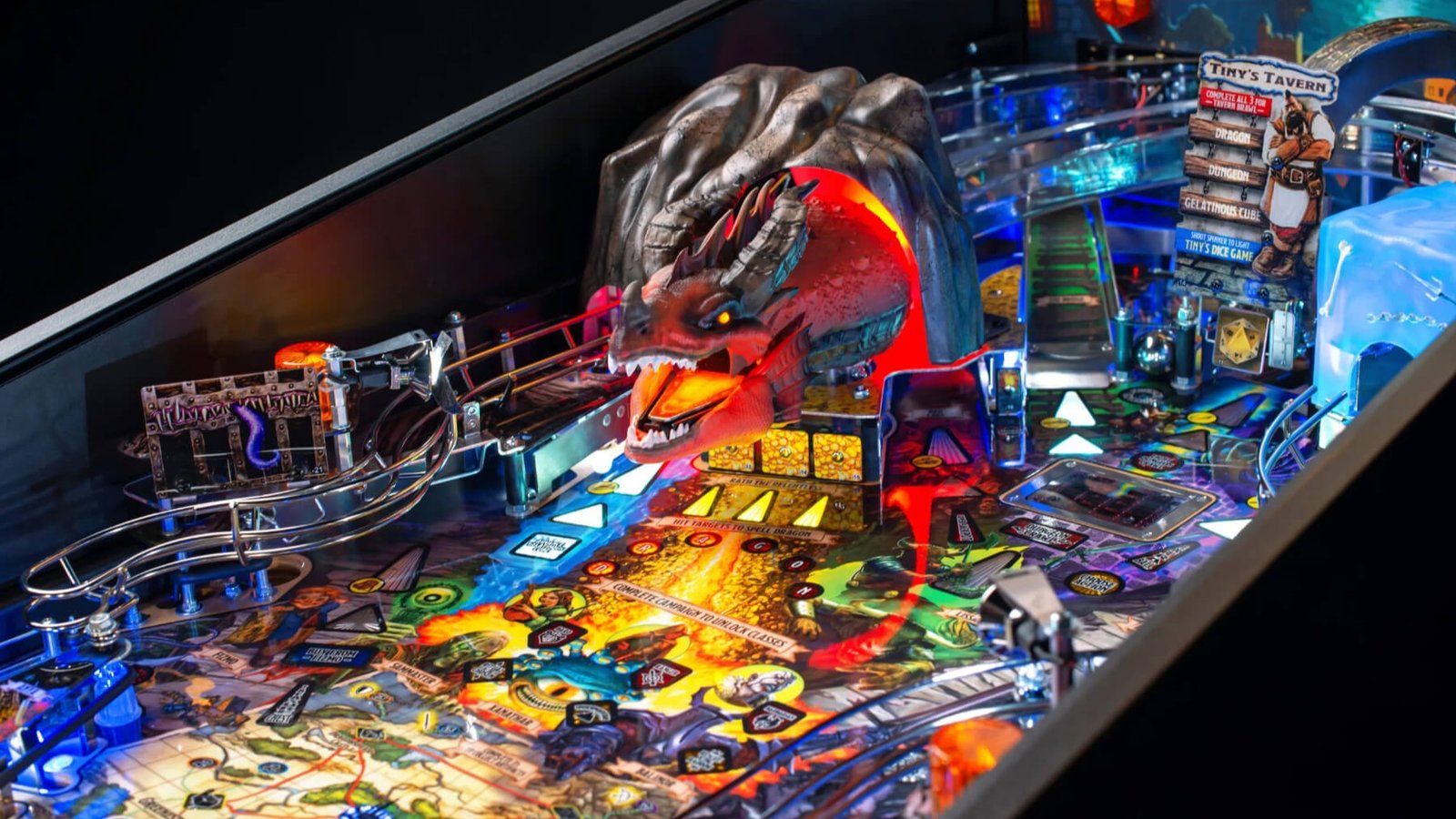
The dragon is the star. Rath the Relentless gives the game a physical identity. On Premium and LE models, the dragon has more movement and can shoot pinballs from its mouth. On the Pro, the dragon is more stripped down but still present. For casual players, that matters. A giant dragon toy is easy to understand. Hit dragon. Dragon reacts. Good.
The deeper rules may take time. The dragon works immediately.
Family Fit: Better Than It Looks, But Not Effortless
For a home game room, D&D is more family-friendly than its rule sheet makes it sound.
The fantasy theme gives people something to latch onto. The monsters, map, dungeon crawl and character classes are easy to talk about, even when the exact scoring is not obvious. A family can pick favorite characters. Someone can care about unlocking the Bard. Someone else can just want to start Dragon Multiball.
That is good home pinball.
The local cooperative play angle also helps. Pinball is often competitive by default, but D&D’s theme makes shared progress feel natural. It fits the idea of a party moving through a campaign. That does not mean everyone in the room will understand the game. It does mean the machine has more social texture than a basic “shoot ramps for points” game.
The downside is explanation fatigue. If one person in the house becomes the rules teacher, they may spend a lot of time saying things like, “No, go here first,” or “You need that mode before the next location,” or “Use the item now.”
Some families enjoy that. Some do not.
My family-fit verdict is simple: D&D is a good family machine if your household likes learning games. It is not the easiest family machine if your household wants instant clarity.
Pro Vs Premium For Casual Players
The Pro vs Premium debate is real here.
The Pro is the better value choice for many casual home buyers. It keeps the core game, the dragon, the shield, the gelatinous cube and the campaign structure. It also comes in at a lower MSRP than the Premium or LE. If you mainly care about rules depth and long-term play, the Pro gives you a lot.
The Premium adds more theater. The dragon has multi-axis movement and can shoot balls from its mouth. The Premium and LE also include the rising dungeon feature that captures the ball for Dungeon Crawl. Those are meaningful additions, especially for a theme like Dungeons & Dragons. If you want the machine to feel like an event every time someone walks up, Premium makes sense.
The LE is more of a collector choice. It adds limited-edition trim, art, shaker, upgraded audio, anti-reflection glass and other presentation details. Those are nice if you want the full package, but they do not make the game more casual-friendly.
For casual players, I would frame it this way:
Buy the Pro if you want the smarter value and do not need every showpiece toy.
Buy the Premium if the dragon and dungeon theater are part of why you want the game.
Buy the LE if you are already committed to D&D as a collector piece.
Home Use Vs Events And Public Play
D&D is much easier to recommend for home use than for short public play.
At home, you can learn the rules slowly. You can log in, save progress, level characters and treat the game like a long-term machine. That is where D&D makes the most sense. It is built for repeat play. It rewards curiosity. It gives you reasons to come back.
For events, parties or office lounges, the answer is more mixed.
A D&D machine will get attention because it looks cool and has a big fantasy theme. But not every event needs a deep campaign game. Sometimes the best event machine is the one that gives guests instant feedback and obvious goals. Hit the castle. Shoot the shark. Bash the toy. Start multiball. Done.
D&D can still work at an event, especially if the crowd likes fantasy, tabletop games or modern Stern machines. But if the audience is mostly casual guests, you would want a simple instruction card near the machine:
Pick a character. Shoot flashing shots. Hit the dragon. Start multiball. Do not worry about understanding everything on game one.
That little bit of framing helps a lot.
For Utah homes, offices and events, this is also the kind of machine where renting before buying makes sense. A few nights with a deep modern game can tell you more than a dozen online comments. Some households will love the campaign structure. Others will realize they want something faster and simpler.
What D&D Does Really Well
The best thing about Dungeons & Dragons pinball is that it feels ambitious in a way that matches the theme.
A D&D pinball machine should not feel thin. It should have monsters, choices, character progress and a sense of adventure. Stern understood that part. The Tyrant’s Eye has a real identity. It is not generic fantasy art with a dragon toy in the corner.
The game also gives casual owners a reason to improve. You are not only chasing a high score. You are trying to see more of the story. That can be more motivating for family players than score alone.
The other big strength is atmosphere. The dragon, callouts, music, art and fantasy setting give the machine a strong presence. Some games are fun but visually flat. D&D does not have that problem. Even if you do not know the rules, you know what world you are in.
Where It Can Frustrate Casual Players
The biggest risk is that D&D can make new players feel like they are always behind the game.
There are modes, colors, map locations, dungeon choices, items, character stats and long-term progress. That is a lot of vocabulary. Even if the machine is guiding you, casual players may not know which choices matter.
The second risk is shot pressure. A deep game is easier to enjoy casually when the layout gives newer players lots of small wins. D&D has some friendly touches, but it still asks for accuracy. If your family already struggles with modern Stern speed, D&D may feel demanding until everyone settles in.
The third risk is that not every D&D fan is automatically a pinball fan. That sounds obvious, but it matters. A tabletop player may love the theme and still not enjoy the physical difficulty of pinball. A pinball player may love the shots and still not care about character progression.
The overlap is powerful. But it is still an overlap.
The Verdict
Dungeons & Dragons pinball is not too much for casual players who want a machine to grow into. It may be too much for casual players who want the whole experience explained in one game.
That is the cleanest answer.
As a home arcade machine, D&D has a lot going for it: theme, story, long-term progress, character unlocks, PinSave and enough physical toys to make the game feel alive. It gives families and owners a reason to keep playing.
As a party or event game, it is more situational. It can absolutely work, but it is not the easiest “walk up and instantly get it” machine. You may need to help people understand the simple version of the goal.
My recommendation: if you like D&D, fantasy, RPG progression or deep modern Stern rules, this should be on your short list. If your main priority is a simple family machine that every guest understands immediately, try it before buying.
That is not a knock against the game. It is just what the game is.
D&D pinball is a campaign under glass. For the right home, that is the whole appeal.
FAQs
Is Dungeons & Dragons Pinball Good For Beginners?
It is playable for beginners, but not fully transparent. New players can shoot flashing shots, hit the dragon and enjoy multiball. They probably will not understand the campaign map, items and character progress right away.
Is D&D Pinball Better For Home Use Or Public Locations?
It is better suited to home use. The PinSave system, campaign progress and character leveling make more sense when the same players return to the machine over time. On location, the game can still be fun, but many players will only see the surface.
Should Casual Players Buy The Pro Or Premium?
Most casual buyers should start by considering the Pro because it keeps the core game at a lower price. The Premium is worth it if the extra dragon movement and rising dungeon feature are a major part of the appeal.
Is The Ruleset Too Complicated For Kids?
It depends on the kid. Younger players can enjoy the dragon, lights and multiballs without understanding the rules. Older kids who like fantasy games may enjoy the progression. Kids who get frustrated by unclear goals may need help.
Does D&D Pinball Require Insider Connected?
No, you can play without treating it like a connected campaign. But Insider Connected and PinSave are a major part of what makes the game special because they let players save character and campaign progress.
Is D&D Pinball A Good Rental Choice?
It can be, especially for a fantasy-loving crowd or a home trial. For a broad public event, a simpler crowd-pleaser may be safer unless you know the audience will enjoy a deeper game.